
- Family offices are not replacing private equity; they are widening the range of strategic capital partners available to founders.
- Family offices have become sophisticated direct investors, and newly formed offices overwhelmingly favor direct deals.
- The core difference is investment horizon: fund-driven timelines versus flexible, often multigenerational holding periods.
- Private equity remains a powerful growth partner, but higher borrowing costs have shifted its value creation toward operational improvement.
- For founders, the right choice is the partner whose incentives and timeline best align with the company’s ambitions.
Who Creates More Value
For years, many founder-led businesses followed a familiar path when seeking growth capital: raise institutional funding, partner with a private equity firm, scale operations and exit within a defined investment cycle.
Today, the landscape looks very different. Private equity remains one of the largest and most influential sources of investment capital in the world, but it is no longer the only option for businesses looking to grow.
Family offices have become increasingly active investors across the lower middle market, real estate, private credit and direct investments. Rather than competing directly with private equity, they are expanding the range of strategic partnerships available to founders.
This reflects a broader evolution across private markets. Businesses are placing greater value on alignment, flexibility and operational support—not simply access to capital. The conversation has shifted from “Who will invest?” to “Who is the right long-term partner?”
Source: FINTRX Q2 2026 Family Office Report; Cerulli Associates; Bain & Company Global Private Equity Report 2026.
Capital Has Become More Specialized
Not long ago, founders seeking institutional investment had relatively few choices. Commercial banks provided debt, private equity provided equity, and public markets offered an eventual exit.
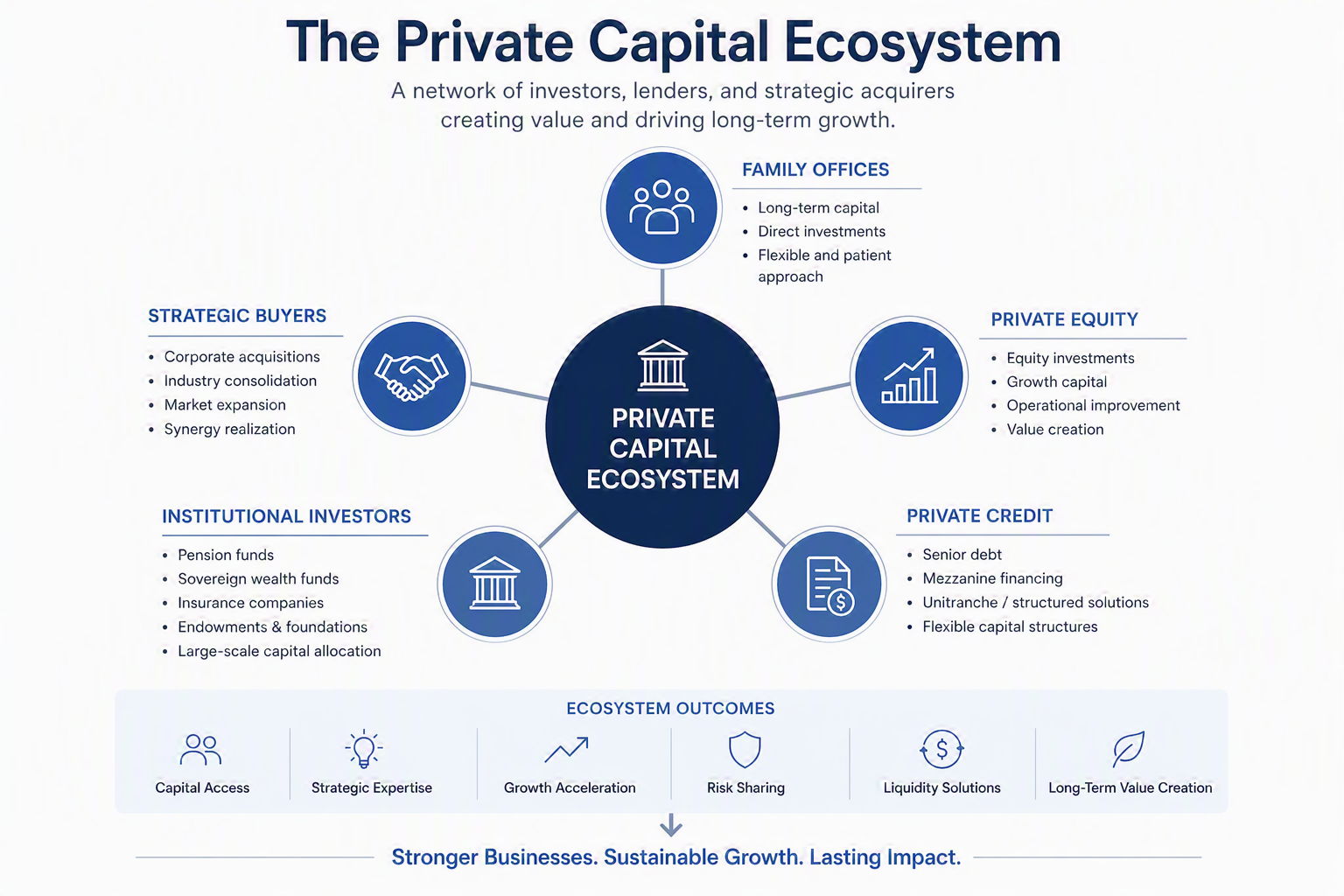
Today’s financing environment is far more sophisticated. Businesses can now combine:
- Traditional bank financing
- Private credit
- Family office capital
- Institutional private equity
- Preferred equity
- Structured capital
- Co-investment partnerships
Each source serves a different purpose. The result is a capital ecosystem that is increasingly customized rather than standardized. For founders, this means the objective is no longer simply raising money. It is selecting the partner whose investment philosophy best matches the company’s long-term ambitions.
Why Family Offices Are Receiving More Attention
One of the biggest changes in private markets has been the rapid professionalization of family offices. Historically, many focused primarily on preserving wealth through public securities, real estate and passive investments.
Today, many have become direct investors. They acquire companies, provide growth capital, invest alongside private equity firms, participate in private credit, build operating platforms and support founder-led businesses. The shift is especially visible among newer offices: of the 96 family offices added to the FINTRX database in the second quarter of 2026, 92.7% listed an interest in direct investments and 89.6% in private equity.1 At the same time, a record 60% of the 307 family offices surveyed by UBS in 2026 said they plan to change their strategic asset allocation within the next 12 months.2
This evolution has been driven by several structural trends:
- The transfer of multigenerational wealth
- Greater institutional sophistication
- Expanded investment teams
- Broader access to private market opportunities
Rather than simply preserving wealth, many family offices are actively allocating capital toward long-term value creation. For founders, that often creates access to investors who evaluate opportunities with greater flexibility than traditional fund structures may allow.
The Difference Is Often Time
Perhaps the most meaningful distinction between many family offices and traditional private equity firms is not investment expertise. It is investment horizon.
Private equity funds typically operate within defined investment cycles. Capital is raised, businesses are acquired, value is created, and investments are eventually exited so capital can be returned to investors.
Family offices frequently operate differently. Because they invest family capital rather than managing institutional fund lives, many have greater flexibility regarding holding periods. That does not necessarily mean they hold investments forever. It means timing is often driven more by business fundamentals than predetermined exit schedules.
For founder-led businesses, this distinction can be significant. Companies built over decades frequently value continuity alongside growth—culture, employees, customer relationships and legacy. These assets often influence partnership decisions as much as valuation.
This also explains why many founders describe family offices differently. Not because they offer more capital, but because they often offer a different type of partnership.
Patient Capital Doesn’t Mean Passive Capital
One of the most misunderstood ideas surrounding family offices is the phrase patient capital. Patient should never be confused with passive.
Many family offices are highly engaged investors. They participate in strategic planning, support acquisitions, provide governance, expand industry relationships, assist with executive recruitment and help professionalize operations.
The difference is that value creation is often viewed through a longer lens. Rather than maximizing outcomes over a fixed investment period, many family offices focus on strengthening businesses that can continue creating value over decades. That philosophy aligns particularly well with founder-led companies whose objectives extend beyond the next liquidity event.
The Enduring Role of Private Equity
The growing influence of family offices should not be mistaken for a decline in private equity. Far from it. Global buyout deal value rose 44% in 2025 to $904 billion, with both deals and exits posting their second-highest values on record.3 Private equity remains one of the most important drivers of business investment globally, providing capital, operational expertise and strategic guidance to companies across industries ranging from manufacturing and healthcare to software, industrial services and real estate.
What has changed is how value is created. A generation ago, investment performance was often associated with financial engineering and leverage. Today’s environment is different. With buyout borrowing costs in the 8% to 9% range and purchase multiples near record levels, Bain & Company concludes that generating attractive returns now requires significantly more operational improvement and revenue growth.3 Greater competition for quality businesses and more complex operating environments have reinforced that shift.
Leading firms now invest heavily in areas such as:
- Digital transformation
- Leadership development
- Pricing strategy
- Operational excellence
- Supply chain optimization
- Data analytics
- Talent acquisition
- Governance and reporting
In other words, the conversation has evolved from acquiring businesses to building stronger ones.
For founders looking to accelerate growth, expand geographically, pursue acquisitions or professionalize management, private equity continues to offer significant advantages. Many firms bring specialized industry expertise, established operating frameworks and extensive transaction experience that can help businesses scale more rapidly.
The distinction is no longer about whether private equity creates value. It is about how that value is created.
Different Capital for Different Objectives
As private markets become more sophisticated, founders are discovering that selecting an investor is becoming just as important as negotiating valuation. Different capital providers bring different strengths. The objective is not to determine which model is superior. It is to determine which model best aligns with the company’s ambitions.
| Consideration | Traditional private equity | Family office |
|---|---|---|
| Investment horizon | Defined fund life | Flexible, often long-term |
| Capital source | Institutional LPs | Private family capital |
| Exit strategy | Typically planned | More adaptable |
| Performance measured | Across the fund’s life | Across generations |
| Decision-making | Structured investment committees | Often streamlined |
| Primary focus | Growth and value realization | Long-term value creation and alignment |
| Operational involvement | Formalized, process-driven | Relationship-driven, bespoke |
| Transaction flexibility | Strong, but mandate-dependent | Often highly flexible |
| Founder legacy | May be secondary to fund objectives | Often a central consideration |
Figure 2: Traditional private equity vs. family office capital.
Neither approach is inherently better. A founder preparing for rapid acquisitions or international expansion may benefit from the institutional resources of private equity. Another founder may place greater value on flexibility, continuity and a long-term partnership that extends beyond a traditional investment cycle. Increasingly, the best decision is the one that aligns incentives—not simply capital.
Why This Evolution Matters Now
The rise of family offices is part of a much broader transformation taking place across private markets. Several structural forces are reshaping how businesses are financed.
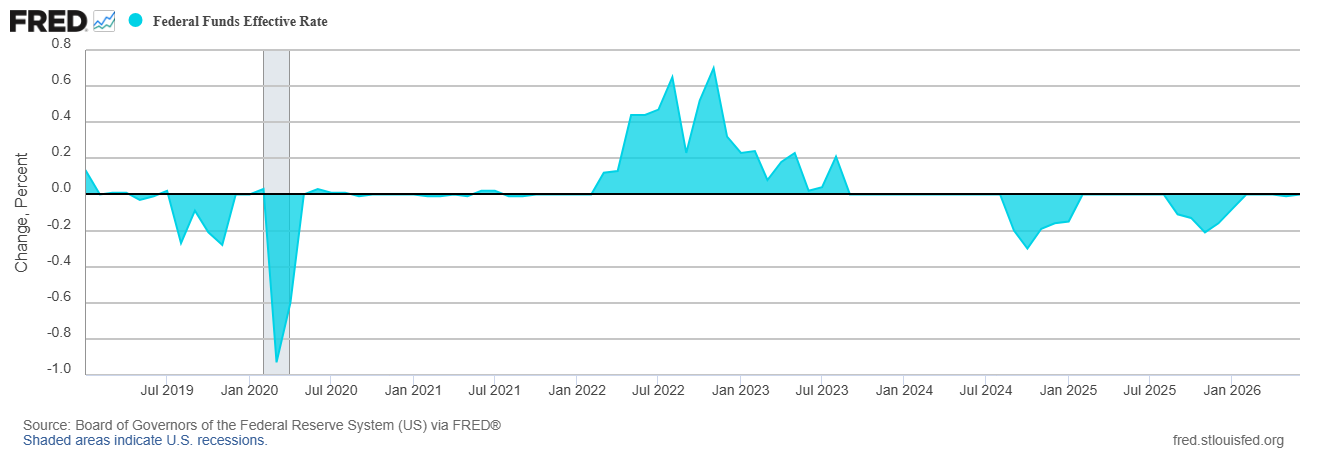
Interest rates remain significantly higher than they were throughout much of the previous decade; in September 2026 the Federal Reserve raised its target range to 3.75%–4.00%, its first increase since 2023.4 Exit markets, while recovering, remain uneven. Private credit has emerged as an increasingly important source of financing, and artificial intelligence is transforming business models across industries.
At the same time, the largest intergenerational wealth transfer in modern history is creating a new generation of family offices that are larger, more sophisticated and increasingly active in direct investing. Cerulli Associates projects that $124 trillion will change hands in the United States through 2048, including $105 trillion passing to heirs.6
Together, these trends are changing the conversation. Businesses are no longer evaluating investors solely on cost of capital. They are evaluating them on experience, flexibility, operational expertise, sector knowledge, decision-making speed and long-term alignment.
“Capital has become more than financing. It has become a strategic resource.”
JLS Capital InsightsWhich Founders Choose Which?
The choice between private equity and a family office often depends on the founder’s priorities.
A founder who wants to accelerate growth, pursue acquisitions and professionalize the business quickly may prefer private equity. These firms often bring operating partners, sector expertise and a clear roadmap for scaling.
A founder who values continuity, discretion and a long-term relationship may prefer a family office. These investors may be more willing to structure a bespoke transaction, preserve the company’s culture and hold the investment for a longer period.
In practice, many businesses are not choosing between “good” and “bad” capital. They are choosing between different forms of good capital—each with its own strengths, expectations and tradeoffs.
The JLS Perspective
At JLS Capital Group, we believe capital should strengthen businesses—not simply finance transactions.
Whether investment comes from a family office, a private equity sponsor or a blended capital structure, the most successful partnerships are built on alignment, strategic thinking and a shared commitment to long-term value creation.
Every business has unique objectives, operating realities and growth opportunities. That is why we believe the most effective capital solutions are those designed around the business itself—not around a predetermined investment model.
For founders, choosing a capital partner is ultimately about more than funding the next stage of growth. It is about finding a partner capable of helping build an enduring business for the years—and generations—ahead.
Sources
1. FINTRX, Q2 2026 Family Office Report, as reported by InvestmentNews, August 18, 2026. investmentnews.com
2. UBS, Global Family Office Report 2026, press release, May 28, 2026, via Jersey Finance. jerseyfinance.com
3. Bain & Company, Global Private Equity Report 2026, press release, February 23, 2026. bain.com
4. NPR, “The Fed raises interest rates for the first time in over three years,” September 16, 2026. npr.org
5. Federal Reserve Bank of St. Louis, Federal Reserve Economic Data (FRED), Federal Funds Effective Rate. fred.stlouisfed.org
6. Cerulli Associates, U.S. High-Net-Worth and Ultra-High-Net-Worth Markets 2024, as reported by NAPA, December 2024. napa-net.org