- Institutional capital is expanding beyond traditional gateway cities as the drivers of long-term value become more geographically diverse.
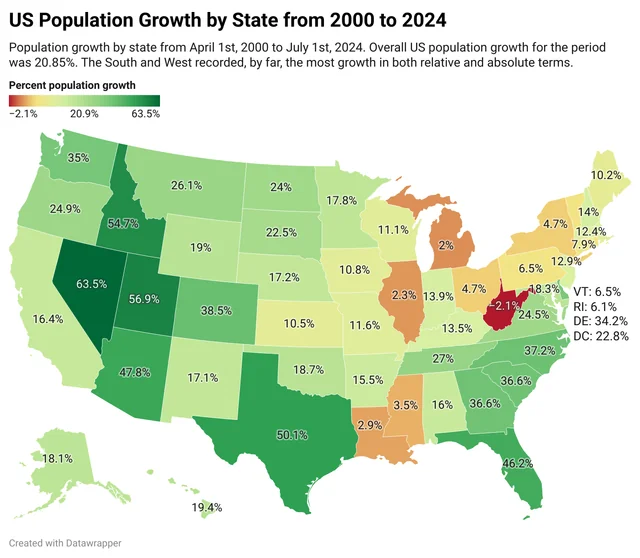
- Population growth is concentrating in the South, which grew 6.0% from 2020 to 2025, nearly double the national rate.
- Corporate relocations and expansions are turning demographic growth into durable economic ecosystems.
- Federal infrastructure and industrial programs are directing capital toward transportation, energy and advanced manufacturing in regional markets.
- Institutional investors favor regional markets for measurable fundamentals, not affordability alone.
Beyond the Gateway Cities
For decades, institutional capital followed a familiar map: New York, Los Angeles, San Francisco, Chicago and Boston. These gateway cities became global investment centers because they combined liquidity, deep labor markets, established industries and international connectivity. For many years, investing in these markets was almost synonymous with investing in long-term stability.
Today, the landscape looks different. Institutional investors are expanding beyond traditional gateways—not because those markets have lost their importance, but because the drivers of long-term value creation have become far more geographically diverse. Population migration, corporate relocation, infrastructure investment, manufacturing reshoring, technological innovation and demographic change are reshaping where businesses expand, where people choose to live and where long-term investment opportunities emerge.
The result is a broader investment landscape in which regional markets are attracting increasing institutional attention—not because they are “secondary” markets, but because many now possess the characteristics that institutional investors value most. In PwC and the Urban Land Institute’s Emerging Trends in Real Estate 2026, which surveyed more than 1,700 industry leaders, Dallas–Fort Worth ranked as the number one market to watch for the second consecutive year, and six of the top ten markets were in the Sun Belt: Dallas–Fort Worth, Miami, Houston, Nashville, Tampa–St. Petersburg and Phoenix.1
Long-term capital has always followed economic fundamentals. Today’s fundamentals simply look different than they did twenty years ago.
Source: U.S. Census Bureau Vintage 2025 estimates; PwC & ULI Emerging Trends in Real Estate 2026; Infrastructure Investment and Jobs Act.
Demographics Continue to Shape Investment Opportunity
One of the strongest predictors of future real estate demand is remarkably simple: people. Population growth remains one of the clearest indicators of where future housing demand, commercial activity, infrastructure needs and business investment are likely to concentrate. When people relocate, capital often follows.
Growing populations require:
- Housing
- Healthcare
- Distribution centers
- Schools
- Retail
- Hospitality
- Transportation infrastructure
- Industrial development
The economic effects extend well beyond real estate. Growing communities attract employers. Employers create jobs, jobs stimulate consumer spending, new businesses emerge and additional investment follows. Over time, demographic momentum becomes economic momentum.
States across the Sun Belt—including Texas, Florida, Tennessee, North Carolina, Arizona and South Carolina—have benefited from this dynamic for more than a decade, creating stronger demand across multiple real estate sectors. According to the U.S. Census Bureau, the South grew by 6.0% between 2020 and 2025, nearly double the nation’s 3.1%, and was the only region to add population in every age group.2 In the most recent year, South Carolina was the fastest-growing state at 1.5%, while Texas added the most residents, more than 391,000.3
Austin provides one of the clearest examples. Rather than being transformed by a single corporate investment, the city evolved through the interaction of talent migration, business expansion, university research, infrastructure investment and entrepreneurial activity. Institutional investors increasingly evaluate markets through this broader ecosystem rather than focusing on individual developments.
Business Investment Creates Lasting Demand
Population alone does not sustain economic growth. Businesses do. Corporate investment frequently becomes the catalyst that transforms demographic growth into long-term economic expansion.
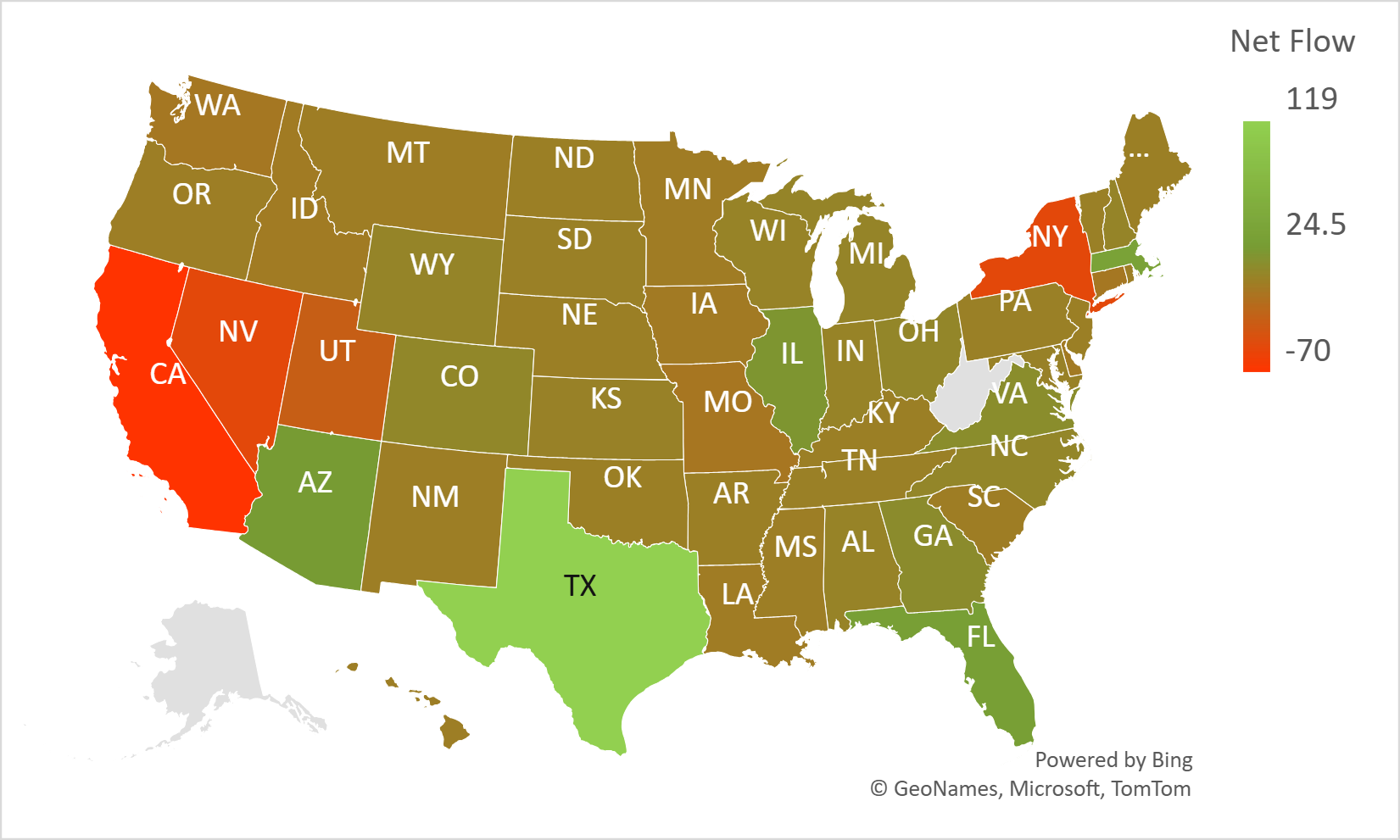
Over the past decade, companies across technology, advanced manufacturing, healthcare, logistics and life sciences have increasingly expanded into regional markets offering favorable business climates, skilled labor and lower operating costs. Hybrid work has accelerated this trend by giving both employers and employees greater flexibility in where they locate. In the 2022–2023 fiscal year, 8.9% of U.S. public companies relocated their headquarters, a seven-year high, with Florida and Texas the largest net beneficiaries and Arizona and Utah also posting strong net gains.4
As companies diversify operations beyond traditional coastal markets, regional business ecosystems continue to strengthen. Universities, research institutions, transportation infrastructure, talent pipelines, supplier networks and innovation clusters each reinforce the others.
Rather than viewing regional markets as isolated opportunities, institutional investors increasingly evaluate complete economic ecosystems capable of supporting sustainable growth across multiple industries.
Infrastructure Is Becoming a Long-Term Competitive Advantage
Infrastructure has always influenced economic development. Today, its importance is growing.
Major public investment programs are directing unprecedented levels of capital toward transportation, energy, broadband, manufacturing and advanced industrial capacity. The Infrastructure Investment and Jobs Act authorized $1.2 trillion for infrastructure and transportation,7 and the CHIPS and Science Act provides $52.7 billion for semiconductor research, manufacturing and workforce development.6 The Inflation Reduction Act added incentives for energy and advanced manufacturing, although several of its clean energy provisions were scaled back in 2025. The regional impact is already visible: in late 2024, the Department of Commerce awarded $6.6 billion to TSMC’s Arizona subsidiary to help build three fabrication facilities in Phoenix.7
These investments rarely affect only one sector. A new semiconductor facility creates demand for housing. Housing supports retail, retail attracts services, and logistics expands. Healthcare follows population growth, and education systems grow alongside local employment. The effects compound over time.
For investors, infrastructure is less about government spending than about understanding where long-term economic activity is likely to concentrate over the next decade.
“Opportunity rarely emerges by following yesterday’s map. It comes from understanding where tomorrow’s economic activity is being built.”
JLS Capital InsightsRegional Markets Offer More Than Affordability
Much of the discussion surrounding regional markets focuses on lower acquisition costs. While pricing certainly matters, institutional investors rarely allocate capital based on affordability alone. Instead, they evaluate a combination of variables that influence long-term returns:
- Employment growth
- Population trends
- Industry diversification
- Infrastructure quality
- Educational attainment
- Business formation
- Capital availability
- Supply-demand dynamics
Viewed together, these indicators often reveal opportunities that headline pricing alone cannot. The strongest regional markets combine attractive valuations with durable economic fundamentals capable of supporting growth across multiple market cycles.
Institutional investing has become increasingly data-driven. Market reputation matters less than measurable long-term fundamentals.
Why This Matters for Investors
Periods of economic transition often redefine where capital creates the greatest value. The current cycle appears to be no exception.
As higher financing costs encourage more disciplined underwriting—the Federal Reserve raised its target range to 3.75%–4.00% in September 2026, its first increase since 2023—investors are placing greater emphasis on markets supported by structural demand rather than short-term momentum.8
Regional markets increasingly satisfy that requirement. Not because they are immune to economic cycles, but because many are benefiting from long-term demographic, industrial and infrastructure trends that extend well beyond a single real estate cycle.
Successful investors recognize that opportunity rarely emerges by following yesterday’s map. It comes from understanding where tomorrow’s economic activity is being built.
The JLS Perspective
At JLS Capital Group, we believe geography alone has never determined investment success. Markets evolve. Economic activity shifts. Capital follows fundamentals.
The increasing importance of regional markets reflects a broader transformation taking place across the U.S. economy—one driven by demographic change, infrastructure investment, business expansion and disciplined capital allocation.
For investors with a long-term perspective, the most compelling opportunities are often found not where capital has historically concentrated, but where enduring economic foundations continue to strengthen.
Sources
1. PwC and Urban Land Institute, Emerging Trends in Real Estate® 2026, press release, November 5, 2025. pwc.com
2. U.S. Census Bureau, Vintage 2025 Population Estimates, June 25, 2026. census.gov
3. NAHB Eye on Housing, “U.S. Population Growth Slows in 2025,” February 2026. eyeonhousing.org
4. Scotsman Guide, “Corporate relocation rate rises to seven-year high.” scotsmanguide.com
5. Vega Economics, U.S. corporate headquarters relocations 2009–2021, as reported by Site Selection. siteselection.com
6. The White House, “Fact Sheet: CHIPS and Science Act,” August 9, 2022. whitehouse.gov (archive)
7. Spectrum News, “Biden administration rushes to spend climate, semiconductor funding,” November 15, 2024. spectrumnews1.com
8. NPR, “The Fed raises interest rates for the first time in over three years,” September 16, 2026. npr.org