
- Family offices have evolved from wealth preservers into sophisticated, long-term strategic investors.
- The sector is growing fast: single family offices are projected to reach about 10,720 by 2030, managing an estimated $5.4 trillion.
- Private markets and direct investments are now central to how family offices deploy capital.
- Patient capital is not passive capital; the strongest family offices are highly engaged partners.
- For founders, alignment and shared entrepreneurial experience can matter as much as valuation.
The Role of the Family Office Has Changed
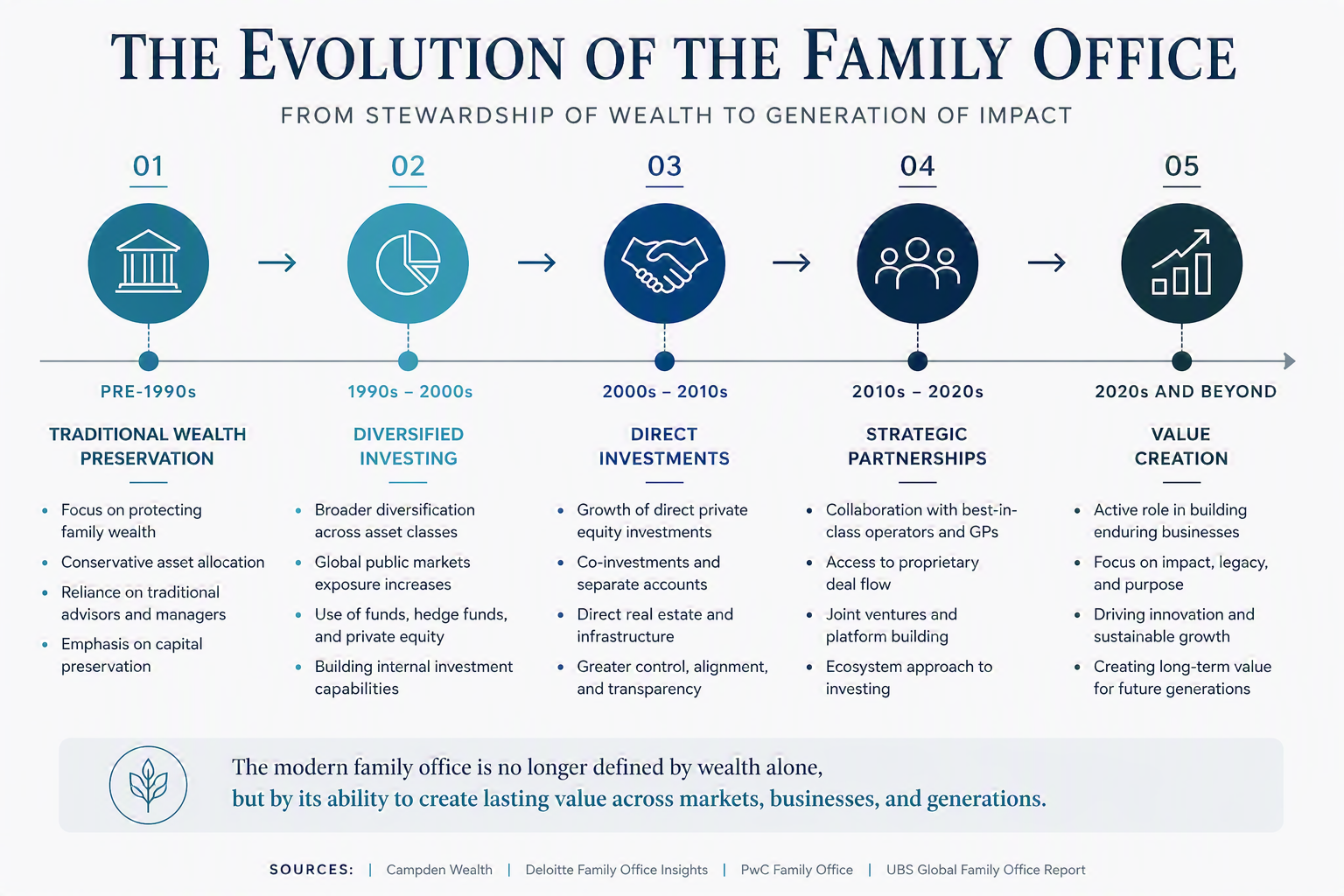
Traditionally, family offices were created with one primary objective: preserve wealth across generations. Their role centered on protecting assets, managing investment risk, coordinating tax strategies and ensuring financial stability for future family members.
Success was often measured by preservation. How effectively could capital survive economic cycles? How efficiently could wealth be transferred from one generation to the next? How could a family maintain financial independence over decades?
Today, that definition has expanded. Modern family offices have evolved into sophisticated investment organizations that actively participate in private markets, direct investments, real estate, private credit, venture capital and operating businesses.
The sector itself is expanding rapidly. Deloitte estimates there were about 8,030 single family offices worldwide in 2024, up from 6,130 in 2019, and projects that number will reach 10,720 by 2030. Over the same period, family office assets under management are expected to rise from $3.1 trillion to $5.4 trillion.1
Rather than functioning only as wealth managers, many now operate as long-term strategic investors—deploying capital with the goal of creating durable value, supporting entrepreneurs and building businesses that can endure across generations.
This evolution reflects a broader transformation in private capital. The question has shifted from “How do we preserve wealth?” to “How can we use capital to create lasting value?”
Source: Deloitte Private, Defining the Family Office Landscape 2024; UBS Global Family Office Report 2026.
From Wealth Preservation to Strategic Ownership
Historically, many family offices relied heavily on traditional portfolio strategies, including public equities, fixed income and externally managed investment vehicles. These approaches remain important. However, the growth of private markets has created new opportunities for families seeking greater control, deeper relationships and longer investment horizons.
Today, many family offices allocate capital across:
- Private equity
- Commercial real estate
- Private credit
- Infrastructure
- Venture capital
- Direct operating businesses
- Strategic partnerships
The objective is not simply financial return. It is ownership. It is understanding businesses. It is participating in value creation.
Unlike public markets, where investors often have limited influence over company strategy, private investments allow family offices to work alongside management teams, support operational improvements and contribute strategic resources over longer periods. The preference for direct involvement is especially strong among newer offices: of the 96 family offices added to the FINTRX database in the second quarter of 2026, 92.7% listed an interest in direct investments.2
This approach reflects a fundamental change in how many families view capital. Capital is no longer only something to protect. It is something to deploy intentionally.
“The modern family office is evolving from managing wealth to actively creating value.”
JLS Capital InsightsWhy Private Markets Have Become Central to Modern Family Offices
One of the defining characteristics of today’s family offices is their increasing participation in private markets. Private investments provide opportunities that are often difficult to access through traditional public markets:
- Greater alignment with management teams
- Direct ownership opportunities
- Longer investment horizons
- Exposure to operational improvements
- Potential access to specialized opportunities
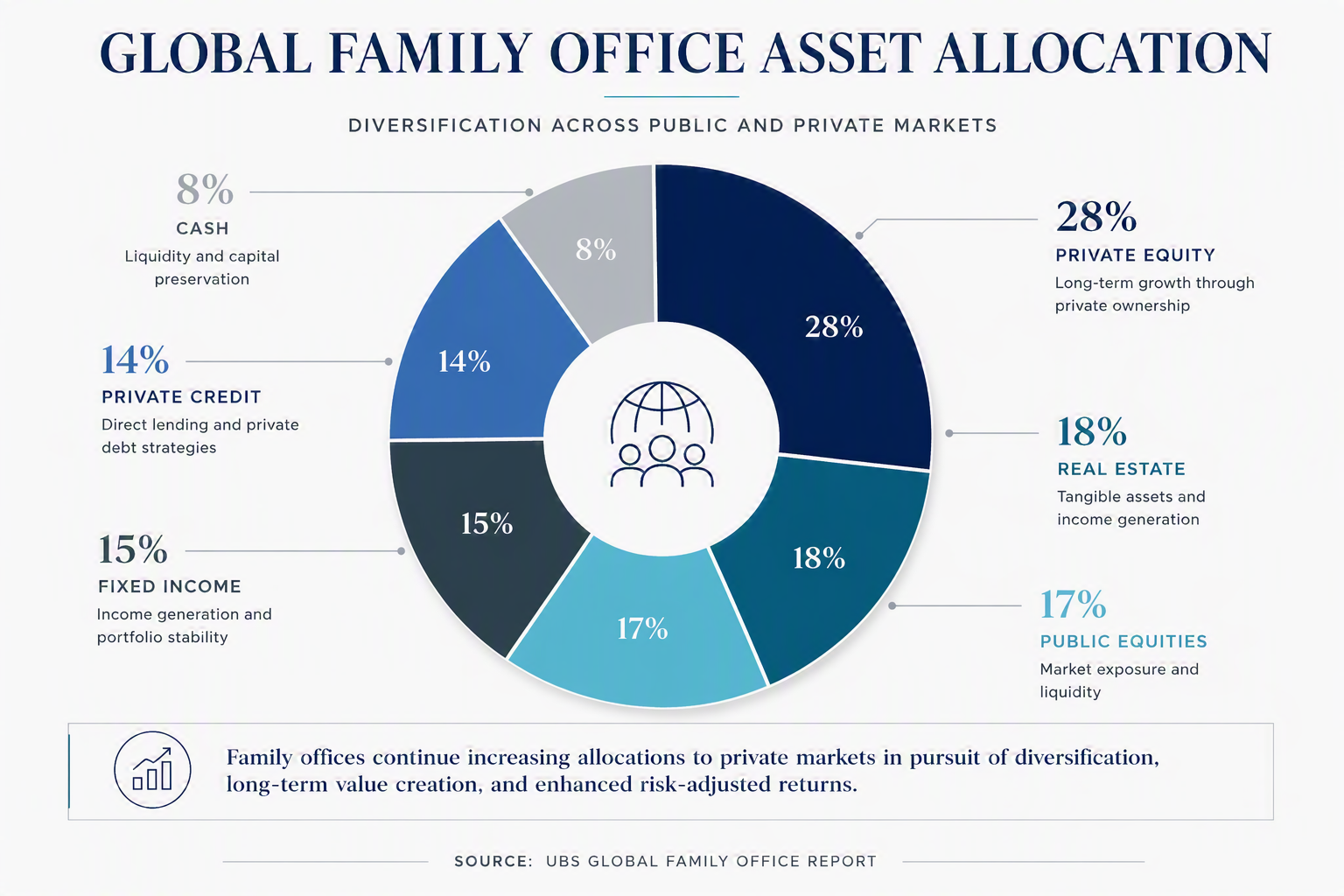
UBS’s Global Family Office Report 2026, which surveyed 307 family offices with an average net worth of $2.7 billion, shows alternatives making up about 42% of the average portfolio. Planned allocations for 2026 include 17% in private equity, 8% in real estate, 3% in private debt and 2% in infrastructure, as families rebalance toward greater diversification.3
The reason is straightforward. Private markets often allow investors to focus less on short-term market movements and more on fundamental business performance. Instead of asking, “What will the market price be tomorrow?” long-term investors often ask, “What can this business become over the next decade?”
That mindset aligns naturally with the way many family offices approach investing. They are often willing to support businesses through periods of transformation, expansion and operational improvement because their investment horizon is not limited by quarterly reporting cycles.
The Rise of Patient Capital
One of the greatest advantages associated with family offices is flexibility. Unlike many institutional investment vehicles that operate within defined fund structures and exit timelines, family offices often have greater ability to evaluate opportunities through a longer-term lens. This approach is often described as patient capital.
Patient capital does not mean passive capital. The most successful family offices remain highly engaged investors. They evaluate businesses carefully, support management teams and seek opportunities where time and strategic execution can create meaningful value.
Patient capital can support:
- Business expansion
- Leadership development
- Strategic acquisitions
- Operational improvements
- Technology investment
- Succession planning
For founder-led companies, this distinction can be significant. Many businesses are not built to maximize value within three or five years. They require time. They require investment. They require partners who understand that sustainable growth is often a multi-year process.
Entrepreneurial Experience as an Advantage
Many entrepreneurial families behind successful businesses have transitioned from operating companies into investment organizations that continue applying the same principles that built their original wealth. The sector remains young and entrepreneurial: according to Deloitte, 68% of family offices were established after 2000, and 41% serve first-generation families.1
Their advantage is often not simply access to capital. It is experience. They understand entrepreneurship because they have lived it. That creates a different type of relationship between investor and company—one based on shared understanding rather than only financial return.
The Founder Perspective: Why Alignment Matters
For many entrepreneurs, choosing an investment partner is one of the most important decisions they will make. The question is no longer only, “How much capital can this investor provide?” It is also, “Will this partner understand where we want to take the business?”
This distinction is especially important for founder-led companies. Many successful businesses are built around more than financial performance. They are built around:
- Customer relationships
- Company culture
- Employee loyalty
- Industry expertise
- Long-term reputation
A founder who has spent decades building a company may prioritize continuity and strategic alignment as much as valuation. This is where family offices can offer a unique advantage. Because many family offices are themselves built by entrepreneurs, they often understand the challenges of ownership transitions, scaling operations and balancing growth with preservation of culture.
For some founders, the ideal partner is not simply the one offering the highest price. It is the one offering the strongest alignment.
Why This Matters in Today’s Market
The evolution of family offices is occurring during a period of significant change across global markets. Interest rates have increased, with the Federal Reserve raising its target range to 3.75%–4.00% in September 2026.4 Technology is transforming industries, artificial intelligence is reshaping business operations, demographic trends are changing consumer behavior, and geopolitical uncertainty continues to influence capital flows. In UBS’s 2026 survey, geopolitical conflict ranked as the top risk for family offices, and a record 60% planned to change their strategic asset allocation within 12 months.5
In this environment, investors and businesses are placing greater importance on flexibility, resilience and strategic decision-making. Family offices are often positioned to respond because they combine several characteristics:
- Long-term investment horizons
- Flexible capital structures
- Entrepreneurial decision-making
- Diversified investment approaches
- Direct relationships with operators and founders
These characteristics allow many family offices to evaluate opportunities beyond traditional investment timelines and focus on long-term value creation. The result is not that family offices replace other forms of capital. Rather, they expand the range of options available to business owners.
Family Offices and the Future of Private Capital
The growth of family offices reflects a broader transformation in private markets. Capital is becoming more specialized, investment structures are becoming more flexible, and founders have more choices than ever when selecting a financial partner.
Traditional private equity firms continue to play a critical role in helping businesses scale, professionalize operations and execute acquisitions. Private credit providers offer alternative financing solutions. Institutional investors continue allocating capital across private markets. Family offices add another important dimension: long-term ownership and strategic flexibility.
The future of private capital will likely not be defined by one dominant model. It will be defined by different types of capital working alongside businesses with different objectives. Some companies will need aggressive expansion. Some will need operational transformation. Some will need succession planning. Some will need a partner willing to invest patiently over decades.
The right capital depends on the right situation.
Looking Ahead
The strongest family offices of the future will likely continue evolving from wealth managers into sophisticated investment organizations. That evolution will be reinforced by the largest intergenerational wealth transfer in modern history: Cerulli Associates projects that $124 trillion will change hands in the United States through 2048.6
The role of family offices will extend beyond protecting financial assets. They will increasingly focus on:
- Building businesses
- Supporting entrepreneurs
- Investing in innovation
- Creating employment
- Developing communities
- Preserving value across generations
This represents one of the most significant shifts in modern investing. Wealth preservation remains important. But increasingly, preservation is achieved through thoughtful creation.
The families and investors that succeed over generations will not simply protect what they have built. They will continue finding ways to create value.
The JLS Perspective
At JLS Capital Group, we believe modern investing requires more than access to capital. It requires discipline, alignment and a long-term perspective.
The evolution of the family office reflects a broader principle we believe strongly in: capital creates the greatest impact when combined with strategic thinking, operational expertise and meaningful partnerships.
Whether investing in private equity, real estate, structured capital or operating businesses, the objective should extend beyond the transaction itself. The goal is to build stronger companies, support sustainable growth and create value that can endure across market cycles and generations.
Sources
1. Deloitte Private, Defining the Family Office Landscape, 2024, Family Office Insights Series – Global Edition. deloitte.com
2. FINTRX, Q2 2026 Family Office Report, as reported by InvestmentNews, August 18, 2026. investmentnews.com
3. UBS, Global Family Office Report 2026, as summarized by Caproasia, June 11, 2026. caproasia.com
4. NPR, “The Fed raises interest rates for the first time in over three years,” September 16, 2026. npr.org
5. UBS, Global Family Office Report 2026, press release, May 28, 2026, via Jersey Finance. jerseyfinance.com
6. Cerulli Associates, U.S. High-Net-Worth and Ultra-High-Net-Worth Markets 2024, as reported by NAPA, December 2024. napa-net.org