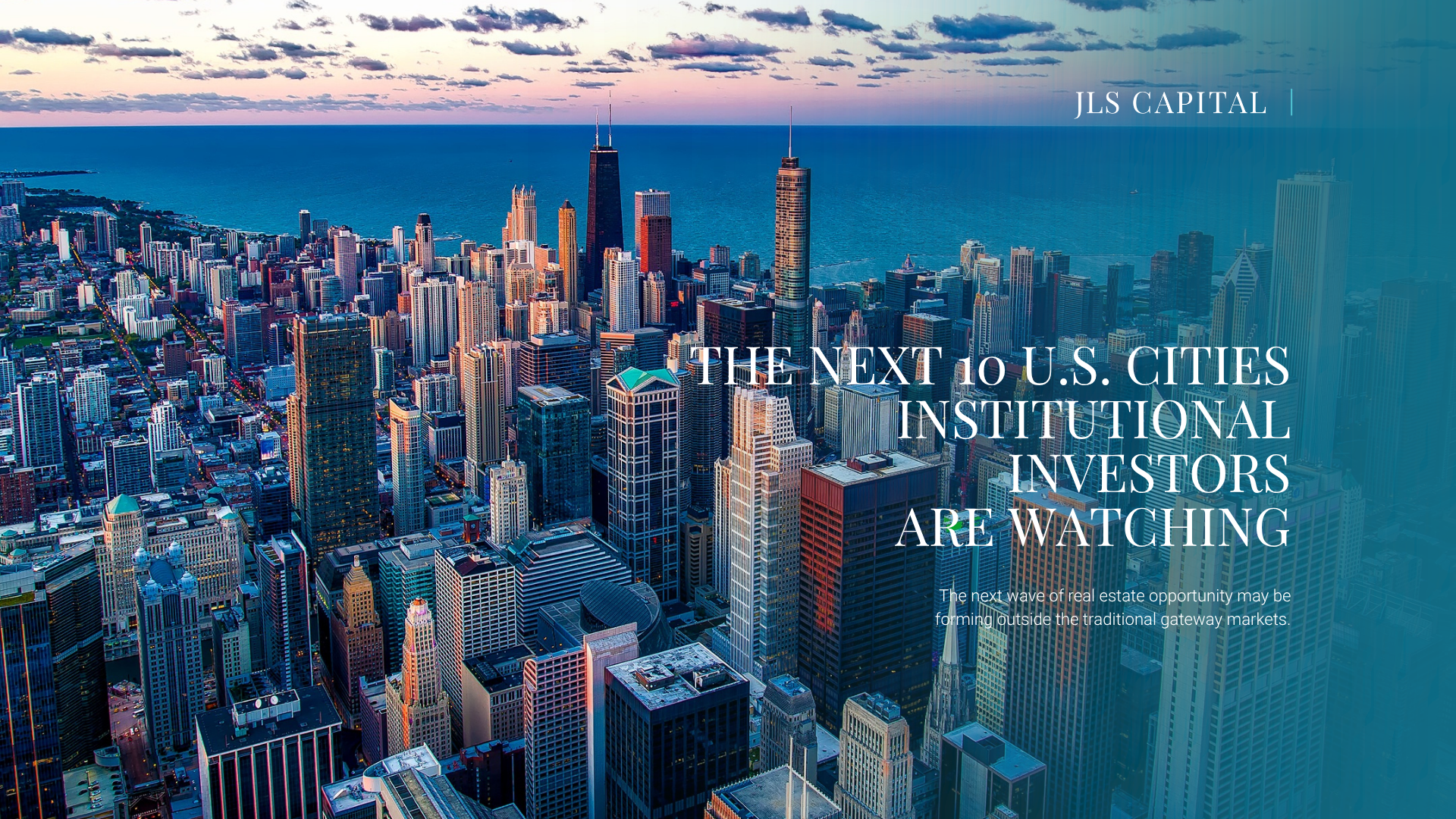
- PwC and ULI’s 2026 ranking shows institutional capital looking beyond traditional gateway cities—without abandoning them.
- Dallas–Fort Worth ranks #1 for the second consecutive year, and six of the top ten markets are in the Sun Belt.
- Four of the ten markets sit in the New York metro region, showing that adjacency and density remain powerful investment theses.
- The common thread is not geography but fundamentals: population, jobs, diversification, infrastructure and connectivity.
- Growth is increasingly happening on metro fringes, so the next opportunity may be the suburb or corridor next to the headline city.
The Map of U.S. Real Estate Is Changing
For decades, institutional real estate investing followed a relatively predictable map: New York, Los Angeles, San Francisco, Chicago and Boston. These markets offered scale, liquidity, established industries, deep talent pools and global connectivity.
They still matter. But something has changed. The geography of economic growth is becoming more complicated. Population is moving. Companies are relocating. Manufacturing is expanding. Infrastructure is being rebuilt. Artificial intelligence is creating entirely new demand for power, land and data infrastructure. And investors are increasingly looking beyond the traditional gateway cities to understand where the next decade of economic activity will be created.
That is why the 2026 Emerging Trends in Real Estate report from PwC and the Urban Land Institute is particularly interesting. Based on insights from more than 1,700 real estate investors, developers, lenders and advisors, the report identifies the markets attracting the most attention for investment and development prospects in 2026.1
The list is revealing. Not because every city on it is guaranteed to outperform, but because it tells us what institutional investors are looking for. And the pattern is bigger than any individual city.
Source: PwC & Urban Land Institute, Emerging Trends in Real Estate 2026.
| Rank | Market |
|---|---|
| 1 | Dallas–Fort Worth |
| 2 | Jersey City |
| 3 | Miami |
| 4 | Brooklyn |
| 5 | Houston |
| 6 | Nashville |
| 7 | Northern New Jersey |
| 8 | Tampa–St. Petersburg |
| 9 | Manhattan |
| 10 | Phoenix |
Figure 1: The 10 U.S. markets to watch in 2026. Source: PwC & Urban Land Institute, Emerging Trends in Real Estate 2026. The ranking uses “markets,” so several entries represent metropolitan or regional submarkets rather than municipal boundaries.
Inside the 2026 Ranking
1. Dallas–Fort Worth: Scale Is Still a Competitive Advantage
If there is one market that institutional investors appear particularly unwilling to ignore, it is Dallas–Fort Worth. It ranks #1 for the second consecutive year in the 2026 PwC/ULI ranking.1
Why? Because DFW combines several investment characteristics that rarely appear together at this scale: population growth, corporate expansion, logistics, manufacturing, technology, infrastructure, a deep labor market and a large, diversified economy. The metro area reached 8.5 million residents in 2025, up 11.0% since 2020, according to the U.S. Census Bureau.2
But the more interesting story is what happens outside the headline. Dallas–Fort Worth is not dependent on one industry. It has developed into an economic ecosystem capable of supporting multiple sources of demand. A market does not become resilient simply because people move there. It becomes resilient when people, businesses, infrastructure and capital reinforce one another. That is the DFW story, and it explains why the market continues to attract institutional attention.
2. Jersey City: The Gateway City Next to the Gateway City
Jersey City is an interesting inclusion because it challenges a common assumption about regional markets. Institutional capital does not always have to leave major metropolitan areas to find growth. Sometimes it moves next door.
Jersey City benefits from its proximity to Manhattan while offering a different cost structure, development environment and real estate opportunity set. Instead of abandoning gateway-city economics, investors can gain exposure to them through adjacent markets. Transportation connectivity becomes critical, and so do residential demand, office repositioning and mixed-use development.
The broader lesson is that metropolitan investment should not always be analyzed city by city. Economic ecosystems often matter more than municipal boundaries.
3. Miami: Global Capital Meets Demographic Change
Miami has become one of the most visible examples of the changing geography of U.S. capital. It benefits from domestic migration, international connectivity, tourism, finance, technology and a growing presence of businesses and high-income residents.
But Miami also demonstrates why investors need to look beyond the headline. Population growth alone is not enough. Insurance costs, construction costs, affordability, infrastructure and climate exposure all matter. For institutional investors, the opportunity is therefore not simply “Miami is growing.” The better question is “Which parts of Miami’s economic ecosystem can remain attractive as the market matures?” That distinction separates demographic investing from disciplined underwriting.
4. Brooklyn: Density Creates Its Own Investment Thesis
Brooklyn’s presence on the list is another reminder that the regional-market story is not simply a Sun Belt story. Brooklyn benefits from proximity to Manhattan, a large population base, transportation infrastructure, cultural institutions, employment density and continued demand for mixed-use environments.
The opportunity here is different from Phoenix or Dallas. It is not primarily about population migration into a lower-cost region. It is about density, adaptability and proximity to economic activity. That creates opportunities across residential, retail, industrial, life sciences and mixed-use development. For investors, Brooklyn illustrates an important point: there is no single definition of a growth market.
5. Houston: Scale, Energy and Economic Reinvention
Houston has something institutional investors value enormously: scale. It is one of the largest metropolitan economies in the United States and remains deeply connected to energy, healthcare, logistics, manufacturing, aerospace and international trade.
But Houston’s investment story is increasingly about diversification. The energy economy remains important, but Houston has expanded well beyond its traditional identity. The market also benefits from broader Texas growth: in the Census Bureau’s Vintage 2025 estimates, Houston added about 126,700 residents in a single year, the largest gain of any U.S. metro, narrowly ahead of Dallas–Fort Worth at roughly 123,600.3
For investors, that creates multiple demand engines—housing, industrial, healthcare, logistics, data infrastructure and commercial development. The more diversified those engines become, the more interesting the market becomes to long-term capital.
6. Nashville: Growth With a Different Economic Profile
Nashville has become one of the clearest examples of a regional market moving into the institutional conversation. Its growth is supported by healthcare, professional services, entertainment, technology, education and population migration.
But the bigger story is not simply that Nashville is popular. It is that the city has developed an economic identity capable of attracting both people and businesses. That matters because population growth without job creation can be temporary. Job creation without housing can create affordability pressure. Corporate investment without infrastructure can create bottlenecks.
The strongest markets tend to create a reinforcing cycle: jobs attract people, people attract businesses, businesses attract capital, capital funds infrastructure, and infrastructure supports further growth. Nashville increasingly fits that model.
7. Northern New Jersey: The Logistics and Connectivity Story
Northern New Jersey may not generate the same headlines as Miami or Nashville. Institutional investors pay attention anyway. Why? Connectivity.
Northern New Jersey sits within one of the country’s most important economic ecosystems, connected to New York City, major transportation infrastructure, ports, airports, dense population centers and enormous consumer demand. That creates particular relevance for industrial and logistics real estate. As supply chains become more regionalized and businesses place greater emphasis on proximity to customers, transportation infrastructure becomes an increasingly important source of real estate value.
The lesson is simple: sometimes the investment thesis is not population growth. Sometimes it is access.
8. Tampa–St. Petersburg: Demographics Meet Diversification
Tampa–St. Petersburg represents another version of the migration story. Florida has attracted significant population and business investment for years, and Tampa Bay has developed a more diversified economy than its traditional reputation might suggest, spanning healthcare, financial services, technology, education, tourism and professional services.
But institutional attention comes with a higher standard of underwriting. Population growth must be weighed against insurance costs, construction economics, infrastructure capacity and affordability, a consideration that is becoming increasingly important across Florida. The lesson is not simply that migration creates opportunity. It is that migration creates demand—and investors still have to determine where that demand translates into durable returns.
9. Manhattan: Gateway Markets Are Not Disappearing
Perhaps the most interesting part of the ranking is what it says about the traditional gateway cities. Manhattan is still #9. That matters. The shift toward regional markets does not mean institutional investors are abandoning major cities. Instead, the investment map is becoming more nuanced.
Manhattan retains advantages that are extremely difficult to replicate: global capital, financial services, talent, culture, transportation, institutional infrastructure and international business. The market is also experiencing a more complicated real estate environment, particularly in office properties. PwC and ULI describe an office sector that is stabilizing, with top-tier buildings in major markets capturing record rents even as overall valuations remain far below pre-pandemic peaks.1
That creates a new form of institutional opportunity. Not broad exposure. Selective exposure. The future of gateway-city investing may be less about owning everything and more about owning the right assets.
10. Phoenix: The Infrastructure Economy
Phoenix completes the list—and perhaps offers one of the clearest examples of where real estate is heading. The market sits at the intersection of population growth, advanced manufacturing, semiconductor investment, logistics, data infrastructure and large-scale development.
The semiconductor story is particularly important. TSMC has raised its planned U.S. investment to $165 billion, centered on its Phoenix site, which is set to include six fabrication plants, two advanced packaging facilities and an R&D center.4 Together with Intel’s operations in the region, this investment has helped create demand that extends well beyond manufacturing facilities: housing, suppliers, transportation, healthcare, retail, industrial space and workforce development.
That is what institutional investors are watching. Not simply the factory. The ecosystem around the factory. And that distinction matters, because the largest long-term real estate opportunities are often created indirectly by economic investment rather than directly by real estate itself.
The Bigger Story Behind the 10 Markets
The most interesting takeaway is not that these ten markets are expected to outperform. It is what they have in common. Across very different geographies, institutional investors are increasingly looking for:
- Population growth – more people create more demand for housing, services, healthcare, retail and infrastructure.
- Employment growth – jobs create sustainable demand rather than purely speculative population growth.
- Economic diversification – markets dependent on a single industry can be more vulnerable to economic shocks.
- Infrastructure – transportation, energy, telecommunications and utilities can determine whether growth is sustainable.
- Technology – data centers, semiconductors, AI infrastructure and advanced manufacturing are creating entirely new forms of real estate demand.
- Connectivity – ports, airports, highways, rail networks and proximity to major employment centers continue to influence asset values.
- Opportunity for repositioning – investors are increasingly interested in markets where existing assets can be improved, repurposed or repositioned.
These themes reflect a broader shift in institutional real estate. PwC and ULI highlight data centers and senior housing as key sectors for 2026—with the first baby boomers turning 80 this year—while pointing to a widening divide between high-quality assets and lower-quality properties.1
The message is clear: institutional capital is becoming more selective, not less active.
“The opportunity is usually visible before it is obvious.”
JLS Capital InsightsThe Hidden Trend: Investors Are Following Ecosystems
This may be the most important insight. The next generation of real estate investing will not necessarily be about finding the city with the fastest population growth. It will be about identifying economic ecosystems that can compound.
Consider what happens when a semiconductor plant enters a market. It creates jobs. Jobs attract workers. Workers need housing. Housing creates retail demand. Retail attracts services. Services require infrastructure. Infrastructure attracts additional businesses, and those businesses create more demand for industrial and commercial space. One investment becomes an economic network.
That is how institutional investors increasingly think. They are not simply buying buildings. They are investing around economic gravity. And that gravity is moving.
The Census Bureau’s recent analysis highlights another important trend: population gains within many major metro areas are increasingly occurring on the outer edges rather than in traditional city centers. In the Dallas–Fort Worth metro, five outer-ring cities more than doubled their population between 2020 and 2025, while the city of Dallas itself grew only about 1.9%.2
That means the next opportunity may not even be inside the city everyone is talking about. It may be the suburb, exurb, logistics corridor or emerging development node connected to it.
What Investors Should Watch Next
The smartest question is not “Which city will be #1 next year?” It is “Which economic forces are strong enough to keep creating demand five or ten years from now?”
That changes the analysis. Instead of simply tracking home prices, investors can watch:
- Corporate relocations
- Employment growth
- Infrastructure spending
- Industrial development
- Data center investment
- Housing supply
- Population migration
- University expansion
- Healthcare investment
- Logistics activity
These indicators often reveal where future real estate demand is forming before it becomes obvious in asset prices. That is where institutional investing becomes interesting. The opportunity is usually visible before it is obvious.
The JLS Perspective
At JLS Capital Group, we believe geography is only the beginning of the investment thesis. The more important question is what is happening beneath the surface. Who is moving? Who is hiring? Where is infrastructure being built? Where is technology creating new demand? Where are businesses putting capital to work?
And perhaps most importantly: where is economic activity becoming durable enough to support long-term value creation?
The next great real estate opportunity may not look like the last one. It may not even be in the city everyone is watching today. But the fundamentals will leave clues.
Capital follows opportunity. Opportunity follows economic activity. And economic activity follows people, businesses, infrastructure and innovation. The investors who recognize that shift early may be the ones who see the next market before everyone else does.
Sources
1. PwC and Urban Land Institute, Emerging Trends in Real Estate® 2026, press release, November 2025. pwc.com
2. U.S. Census Bureau, “Population Gains in Metro Areas Driven Largely by Growth in the Exurbs This Decade — With Some Exceptions,” May 2026. census.gov
3. U.S. Census Bureau, Vintage 2025 metro area estimates, March 26, 2026, as reported by Hoodline. hoodline.com
4. Arizona Technology Council, “TSMC to Scale Up to a GIGAFAB Cluster in Arizona.” aztechcouncil.org