- Boeing’s quality failures were the symptom; the underlying issue was a supply chain architecture that diluted end-to-end control.
- Outsourcing development and production risk looked capital-efficient on paper but created costly coordination problems, most visibly on the 787.
- In 2025, Commercial Airplanes revenue grew 82% to $41.5 billion, yet the division still lost $7.1 billion.
- Reacquiring Spirit AeroSystems shows Boeing paying to reverse a structural decision made two decades earlier.
- Revenue recovery is not the same as operational health; someone has to own critical complexity end to end.
It’s tempting to describe Boeing’s last several years as a story about quality failures—door plugs, fuselage defects, grounded fleets. That’s accurate, but it’s the symptom, not the disease. The deeper story is about what happens when a company spends decades distributing its manufacturing complexity across an ever-widening network of suppliers, risk-sharing partners and outsourced engineering, until no single organization—including Boeing itself—fully controls the system building its aircraft.1
That is the real subject of this piece, and of this new JLS series, Business Model Deep Dive: not whether a company is well-run in a given quarter, but whether the structure of how it operates is quietly building risk that eventually has to be paid for—in cash, in trust or in both.
Source: The Boeing Company, fourth-quarter and full-year 2025 results, January 27, 2026.
How the Complexity Was Built
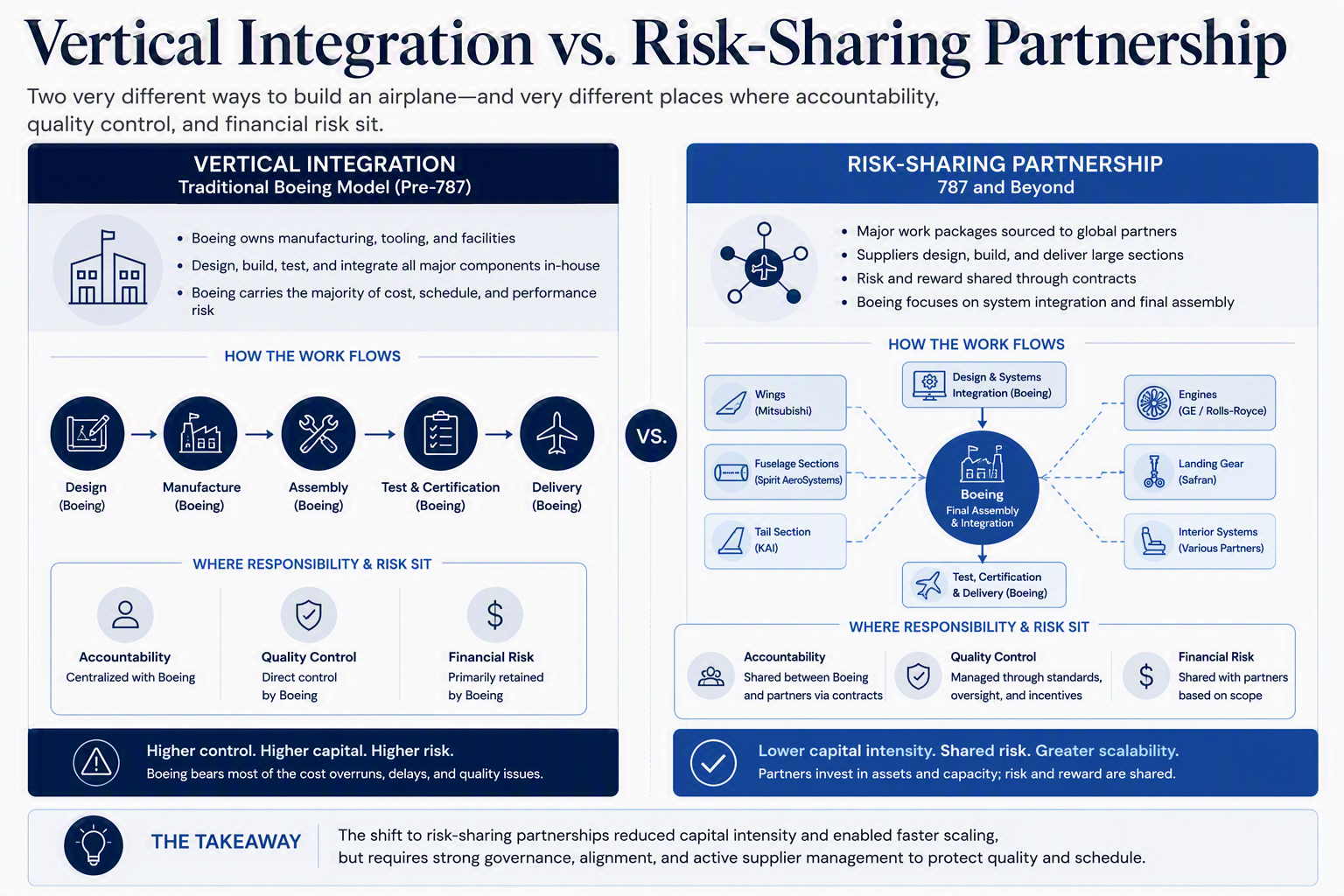
Boeing’s outsourcing strategy wasn’t a mistake in the conventional sense. It was a deliberate, once-celebrated model: shift capital-intensive manufacturing and even development risk onto specialized suppliers, keep Boeing focused on systems integration and final assembly, and let risk-sharing partnerships absorb the upfront R&D burden. On paper, this looked like a more capital-efficient way to build an airplane.
In practice, the model created a kind of coordination debt—incentive misalignment, delayed problem-solving and diluted accountability that accumulate when the people doing the engineering and the people responsible for the finished product are separated by multiple corporate boundaries. The 787 Dreamliner program is the clearest case study. Boeing coordinated more than 300 global suppliers, with major structures built in Japan, Korea, Italy, Kansas and South Carolina, and the difficulty of managing that network extended development timelines by years and drove costs sharply higher—the very costs Boeing had sought to avoid by outsourcing in the first place.2
When the Debt Comes Due
Complexity of this kind doesn’t announce itself immediately. Capacity issues, tooling problems and quality drift can sit below the surface for years before they become visible as production disruption—and by the time they surface, the cost of fixing them is far higher than the cost of preventing them would have been.1 That’s effectively what happened to Boeing across the 737 MAX, 787 and 777X programs: certification delays, quality escapes and regulatory scrutiny that compounded across multiple aircraft families at once rather than remaining contained to one troubled program.
The financial picture makes the scale of the reckoning concrete. Boeing’s 2025 revenue reached $89.5 billion, up from $66.5 billion in 2024, and Boeing Commercial Airplanes (BCA) revenue grew 82% to $41.5 billion as deliveries rose to 600 aircraft. Yet BCA still posted a $7.1 billion operating loss for the year—only a modest improvement from the prior year’s $8.0 billion loss.3
Recovery has continued into 2026, but slowly. BCA’s operating margin improved from −6.1% in the first quarter to −2.7% in the second, leaving the division at −4.2% for the first half, even as the 737 program began transitioning to a production rate of 47 aircraft per month and second-quarter deliveries reached their highest level since 2018.4
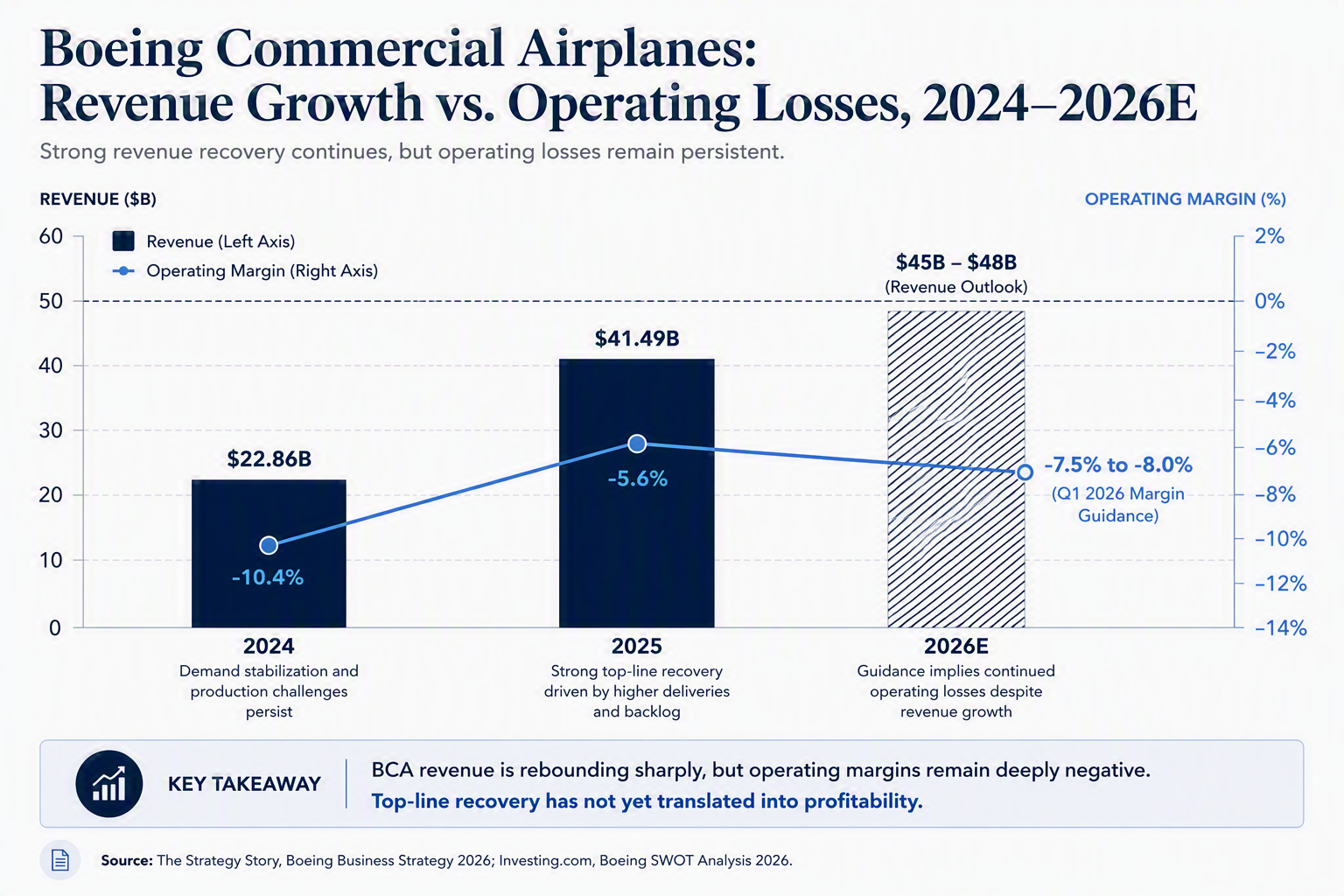
That gap between revenue recovery and economic recovery is the single most important number in this story. A company can grow the top line substantially and still be structurally unprofitable if the underlying operating system—quality, supply chain, certification—hasn’t been repaired.
“Boeing didn’t lose its engineering excellence overnight. It lost control of its own supply chain, one outsourcing decision at a time.”
JLS Capital InsightsThe Strategic Reversal: Buying Back What It Sold
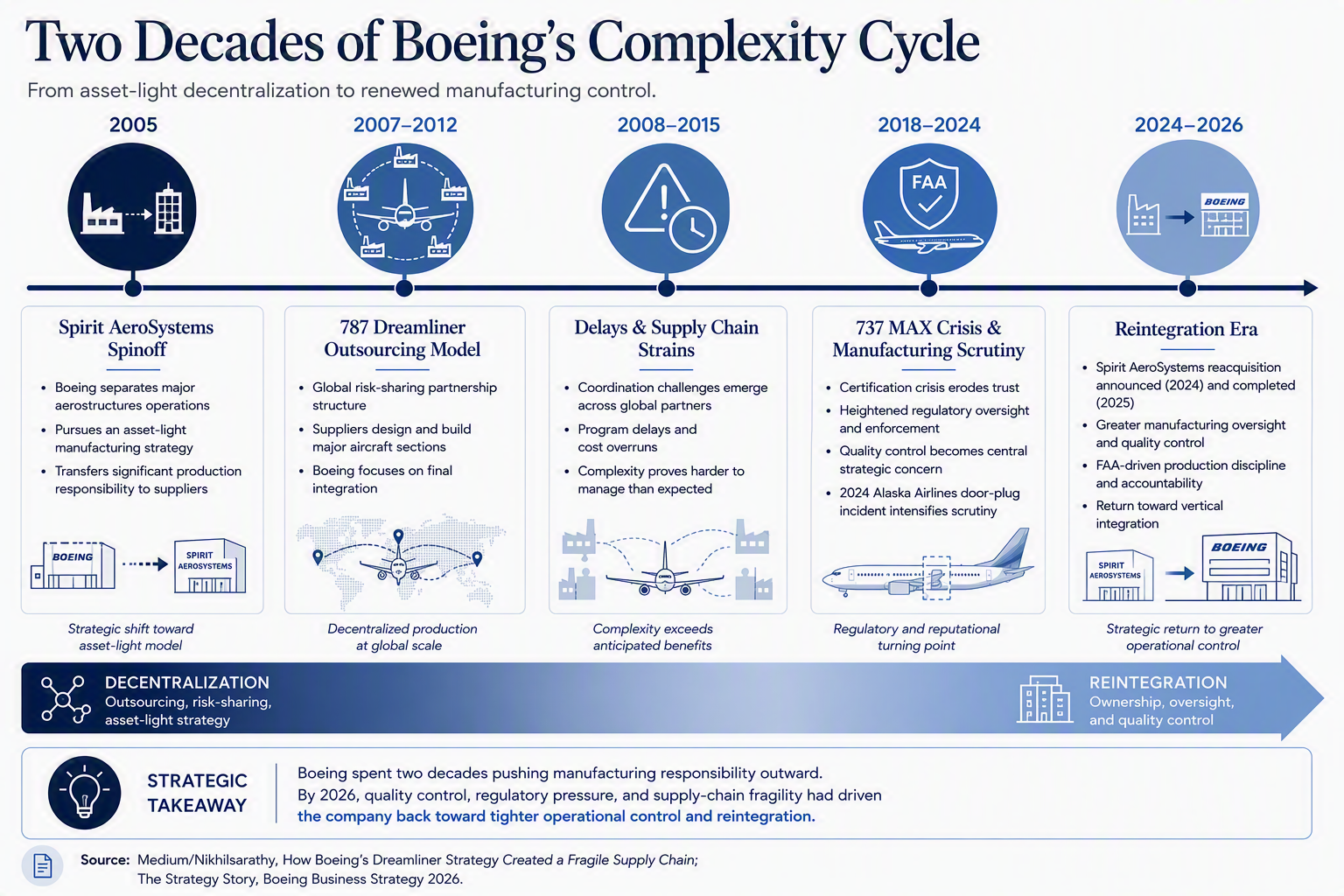
Perhaps the clearest admission of how far complexity had outrun control is Boeing’s decision to reacquire Spirit AeroSystems, the fuselage supplier created in 2005 when Boeing divested its Wichita operations in the name of capital efficiency and supplier specialization. The acquisition closed in late 2025, and Boeing’s fourth-quarter results already reflected its financial impact on the Commercial Airplanes segment.3 The logic is straightforward: integration can improve coordination between engineering, quality, production and supply chain activities that a customer-supplier boundary had previously fragmented.
This is a company paying, at real financial cost, to undo a structural decision it made twenty years earlier in pursuit of efficiency. That is what it looks like when operational complexity crosses the line from an execution challenge into a strategic risk: the fix isn’t a better quarter. It’s reversing the architecture of the business itself.
The Broader Lesson: Complexity Is Not Neutral
The instinct in most industries is to treat outsourcing, specialization and distributed manufacturing as a straightforward efficiency gain—less capital tied up, more flexibility, access to specialized expertise. Boeing’s experience is a reminder that complexity is never free. It simply defers its cost, and that cost tends to compound rather than stay flat. As one recent supply chain analysis put it, tier-one suppliers are not just vendors, and the data layer only helps if the operating layer is governed.1 In aerospace, where certification requirements are unforgiving and safety margins are effectively zero, that deferred cost eventually shows up as production halts, regulatory intervention and a level of scrutiny that makes every future decision slower and more expensive.
The lesson generalizes well beyond aircraft manufacturing. Any business—industrial, healthcare, technology—that distributes critical functions across a wide network of external partners is making the same trade Boeing made: efficiency today, in exchange for coordination risk that accumulates quietly until something forces it into the open. The question worth asking of any operationally complex business isn’t whether it’s currently running smoothly. It’s whether anyone in the organization actually has end-to-end visibility and control over the parts that matter most.
The JLS Perspective
Boeing’s story is ultimately a case study in something JLS Capital Group thinks about in every operating business we evaluate: growth and revenue recovery are not the same as operational health. A business can look like it’s recovering on the income statement while the structural discipline underneath it—quality control, supply chain governance, accountability for the parts that actually create or destroy value—remains unresolved.
That distinction is exactly why our approach to value creation centers on operational excellence as a discipline, not a talking point. The businesses worth backing are the ones where someone owns the complexity end to end, not the ones that have simply distributed it until it becomes someone else’s problem—until, eventually, it becomes everyone’s.
Sources
1. Logistics Viewpoints, “Boeing and the Supply Chain Cost of Industrial Complexity,” April 24, 2026. logisticsviewpoints.com
2. Venkataraman, Operations Management: Managing Global Supply Chains, case notes, “Lean Global Supply Chains and Boeing’s Dreamliner,” SAGE Publishing. sagepub.com
3. The Boeing Company, “Boeing Reports Fourth Quarter Results,” Form 8-K, January 27, 2026. sec.gov
4. The Boeing Company, “Boeing Reports Second Quarter Results,” Form 8-K, July 28, 2026; first-quarter 2026 results, Form 8-K. sec.gov