
- Family offices and private equity are converging: the useful question is no longer which model is better, but which partner can make a specific business more valuable.
- Family-office direct investment more than doubled in 2025, while private equity can no longer rely on leverage and multiple expansion, so operating capability now drives returns.
- Founders should judge capital partners on horizon, operating support, AI, sector expertise, flexibility, follow-on capital, alignment and governance, not on the label.
The Debate Is More Complicated Than It Looks
For founders considering outside capital, the conversation often begins with a familiar question: family office or private equity?
It sounds like a simple comparison. One offers patient capital; the other offers institutional resources. One may hold for decades; the other typically operates within a defined fund structure. One may emphasize relationships and flexibility; the other may bring a highly developed operating model and significant transaction expertise.
But this framing misses the more important question.
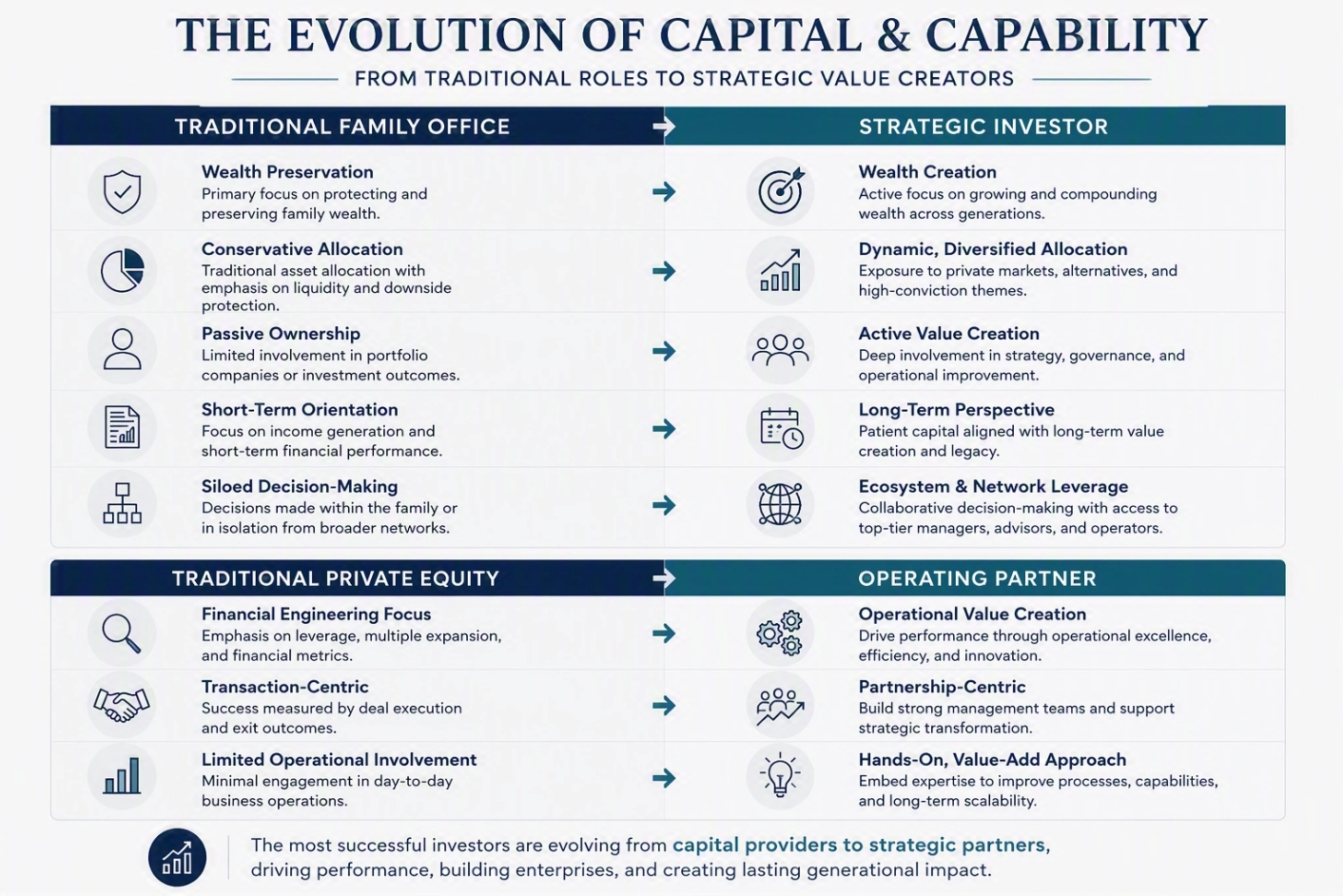
In 2026, the difference between family offices and private equity is becoming less about what they are and more about how they create value. Family offices are becoming more sophisticated direct investors, while private equity firms are building operating capabilities, using artificial intelligence, specializing by sector, and extending holding periods when the business requires it.1
In other words, the two models are evolving toward some of the same objectives. The real distinction is not family office vs. private equity. It is:
Which partner is best equipped to help this particular business become more valuable?
The Family Office Model Is Changing
Family offices were traditionally associated with wealth preservation. That model still exists, but many family offices have become significantly more sophisticated investment organizations.6
They increasingly invest directly in operating businesses, participate in private equity transactions, provide private credit, acquire real estate, and build long-term investment platforms. And the shift is measurable.
Source: S&P Global Market Intelligence2
S&P Global reported that global family-office direct investment activity more than doubled in 2025, rising 123.3% year over year to $12.9 billion across 158 transactions.2
That matters because direct investment changes the relationship between capital and business. Instead of investing through a fund managed by someone else, a family office can negotiate directly with management, structure a customized transaction, and set its own investment horizon.
“The family office becomes more than an allocator. It becomes an owner.”
JLS Capital InsightsAnd ownership can create a different level of alignment.
Private Equity Is Changing Too
It would be a mistake, however, to assume that private equity has stood still. It hasn’t. The industry is entering a more mature and demanding phase.
McKinsey’s 2026 Global Private Equity Report describes a market in which the traditional tailwinds of falling interest rates, expanding multiples, and abundant leverage have weakened. Operational value creation, leadership, AI, and disciplined entry pricing are becoming increasingly important to returns.3
Bain’s 2026 report makes the point even more sharply: “12 is the new 5.” Today’s deals may require substantially faster EBITDA growth to achieve the returns investors historically expected over shorter holding periods, which puts greater pressure on operating teams and value-creation plans.4
This is a fundamental shift. Private equity can no longer assume that financial engineering will do most of the work. The business itself has to improve, which means:
- Stronger leadership
- Better pricing
- More efficient operations
- Technology adoption and AI implementation
- Customer retention
- Strategic acquisitions
- Disciplined capital allocation
The best private equity firms are increasingly behaving less like financial owners and more like operating organizations.
So What Actually Matters?
If both models are evolving, the traditional comparison becomes less useful. Founders should instead evaluate capital partners across eight dimensions.
1. Investment Horizon
This is one of the clearest differences. Traditional private equity funds operate within defined fund structures: capital is raised, deployed, managed, and ultimately returned to investors. That structure creates discipline. It also creates a timeline.
Family offices often have more flexibility because they invest family capital rather than operating within a closed-end fund cycle. That can allow an investment to stay in place longer when the business requires it.
But founders should be careful: longer-term capital does not automatically mean better capital. A family office can still have a short-term mindset, and a private equity firm can still be an excellent long-term partner. The better question is: how does this investor behave when the original timeline changes?
- What happens if the business needs another two years to reach its potential?
- What happens if an acquisition opportunity appears late in the investment period?
- What happens if market conditions make an exit unattractive?
The answers reveal far more than the label on the investor.
2. Operational Expertise
Capital does not operate a company. People do. This may be the most important consideration for a founder, because a capital partner should be judged on what happens after closing:
- Does the investor have operating partners?
- Can they help recruit executives and improve pricing?
- Do they understand technology implementation?
- Can they support acquisitions and help professionalize reporting?
- Have they navigated difficult operating environments before?
These questions matter because operational value creation has become central to private-market performance. McKinsey’s 2026 research found that PE firms are expanding their operating capabilities and involving operating teams earlier in the investment process. It also found that value-creation strategy ranks among the most important criteria LPs use when selecting private equity managers.3
The takeaway: operational capability is becoming an investment capability.
3. AI Capability
This is becoming a major differentiator in 2026. AI is no longer simply a technology investment; for investors, it is becoming part of underwriting. Private equity firms increasingly evaluate how AI could affect revenue growth, margins, customer acquisition, labor productivity, software development, and competitive positioning.
McKinsey reports that only a small share of GPs currently see high AI impact in their own investment processes, but a much larger share expects significant impact within three to five years.3 Family offices are paying attention too: J.P. Morgan’s 2026 Global Family Office Report found that 65% of family offices plan to prioritize AI, while many still have limited exposure to the infrastructure and growth investments behind the technology.5
The question is no longer whether an investor talks about AI. It is whether the investor can help a portfolio company use it economically: to reduce costs, improve pricing, increase sales productivity, automate back-office processes, improve customer experience, or create new products.
An investor who can answer those questions is potentially far more valuable than one simply promising access to capital.
4. Sector Expertise
Size gets attention. Specialization often creates the advantage.
McKinsey’s 2026 research found that specialist buyout funds outperformed generalist peers across several return measures for 2010–2022 vintages, with higher pooled IRRs and lower loss ratios.3 The implication reaches beyond private equity. A founder should ask: does this investor understand my industry?
- A healthcare services company may benefit from an investor who understands reimbursement, staffing, regulation, and consolidation.
- An industrial business may need someone who understands procurement, manufacturing, supply chains, and automation.
- A software company may need expertise in pricing, recurring revenue, product development, and AI disruption.
A family office with deep experience in one industry can provide extraordinary value. So can a specialized private equity firm. The important variable is not the structure; it is the knowledge advantage.
5. Transaction Flexibility
Not every founder wants the same transaction. Some want to sell 100%; others want to keep significant ownership. Some want growth capital without giving up control; others want a full transition. Some need acquisition capital, a recapitalization, succession planning, or a partner who can invest more later.
This is where family offices can have an advantage. Because they may not be constrained by a fund mandate, they can often structure more bespoke transactions.
Private equity can offer substantial flexibility too, through continuation vehicles, co-investment structures, minority investments, growth equity, and other evolving private-market structures.7
So the question is not what does the investor call itself? It is how much flexibility can this investor actually provide?
6. Follow-On Capital
A transaction is rarely the end of the capital requirement. Often it is the beginning. The company may later need:
- Acquisition financing
- Growth capital
- New facilities
- Technology investment
- Working capital
- International expansion
- Management incentives
A large private equity firm may have substantial resources across multiple funds and financing relationships. A family office may have significant permanent capital and the ability to reinvest directly. Neither should be assumed to have unlimited capacity.
The question is: can this partner fund the next chapter if the opportunity is larger than the first transaction?
7. Founder Alignment
This may be the factor founders underestimate most. The right investor needs to understand what the founder actually wants: maximum valuation, partial liquidity, succession, growth, a strategic acquisition, preserving the company’s culture, building a larger enterprise, or creating generational wealth.
These objectives lead to very different transactions. A founder who wants to build for another decade may not want the same partner as one who wants a complete exit within two years, and that is perfectly rational.
There is no universally correct capital structure. There is only the structure that best fits the company’s objectives.
8. Governance and Decision-Making
Capital partners also differ in how decisions get made. Private equity firms generally operate through formal investment committees, governance structures, reporting systems, and institutional processes. That can be a major advantage: it creates accountability, consistency, and institutional discipline.
Family offices can operate with fewer layers and faster decisions, which is valuable when a transaction requires speed. But fewer layers can also mean greater dependence on the individuals making the decision.
For founders, the question is not just “How fast can you make decisions?” It is “How will decisions be made when things become difficult?” That is where governance becomes critical.
The Real Comparison
When founders strip away the labels, the comparison becomes much clearer.
| What matters | Family office | Private equity |
|---|---|---|
| Investment horizon | Often flexible | Typically fund-driven |
| Capital source | Family capital | Institutional LP capital |
| Operational support | Highly variable | Often formalized |
| Sector specialization | Highly variable | Often strong |
| Transaction flexibility | Potentially high | Mandate-dependent |
| Follow-on capital | Depends on family resources | Often significant |
| Governance | Often bespoke | Institutionalized |
| AI capabilities | Increasing rapidly | Increasing rapidly |
| Acquisition expertise | Varies widely | Often substantial |
| Founder legacy | Can be central | Depends on sponsor |
| Decision-making | Potentially faster | More structured |
| Long-term ownership | Often possible | Increasingly flexible |
The table reveals significant overlap. The strongest family offices increasingly look like sophisticated investment firms, and the strongest private equity firms increasingly look like operating organizations. The distinction is becoming less binary.
The Rise of the Hybrid Capital Model
Perhaps the most interesting development is that the future may not be about choosing one model at all, but about combining them.
Family offices increasingly co-invest alongside private equity firms, and private equity firms increasingly work with family offices as capital partners.8 Companies can combine equity, private credit, structured capital, and strategic investors. The capital stack itself is becoming more customized.
That raises another question: why choose one source of capital when different sources can solve different problems?
A founder might use private credit for acquisition financing, family-office equity for long-term ownership, and institutional private equity for a broader expansion strategy. The best structure may be the one that combines the strengths of several capital providers.
What Founders Should Actually Ask
Before selecting an investor, founders should ask questions that go beyond valuation:
- Investment horizon: What happens if the business needs more time than expected?
- Operations: What specifically will you do to help improve the business?
- Leadership: How do you support management teams?
- Capital: How much additional capital can you provide if the opportunity expands?
- AI: How are you helping portfolio companies turn AI into measurable economic value?
- Governance: How are difficult decisions made when management and investors disagree?
- Alignment: What does success look like for you five years from now?
- Legacy: What happens to the culture, team, and legacy of the company after the transaction?
The answers are often more revealing than the valuation.
The 2026 Lesson: Capital Is Becoming a Capability
The most important development across private markets is not that family offices are replacing private equity. They aren’t. It is that capital itself is becoming more specialized.
Investors are competing on more than check size. They are competing on operating expertise, sector knowledge, AI capabilities, speed, flexibility, networks, governance, talent, and long-term alignment.
Family offices are becoming more institutional. Private equity firms are becoming more operational. Private credit is becoming more strategic. And founders have more choices.
That is ultimately good for the market: it forces investors to earn their position as partners.
Looking Ahead
The best capital partner may not be the one offering the highest valuation, the largest fund, or the longest holding period. It may be the investor who understands exactly what the business needs next, and has the experience, capital, and patience to help deliver it.
The real question is not family office or private equity? It is who can make this business stronger?
In a market where leverage and multiple expansion can no longer do all the work, value must increasingly come from the business itself. That makes the quality of the partner more important than ever.
The JLS Perspective
At JLS Capital Group, we believe capital should be evaluated by what it enables, not simply by how much is invested.
The right capital partner should bring more than funding. It should bring perspective, operational understanding, strategic flexibility, long-term alignment, and the ability to help management see opportunities that may not be visible on a balance sheet today.
Whether the capital comes from a family office, a private equity sponsor, a private credit provider, or a combination of sources, the objective remains the same: build a stronger business.
Because the best investment partnerships are not defined by the transaction that begins them. They are defined by the value created after it.
References
1. McKinsey & Company, Global Private Equity Report 2026; Bain & Company, Global Private Equity Report 2026; McKinsey & Company, Global Private Markets Report 2025.
2. S&P Global Market Intelligence, Global family office direct investments more than double in 2025.
3. McKinsey & Company, Global Private Equity Report 2026; McKinsey & Company, Bridging Private Equity’s Value Creation Gap.
4. Bain & Company, Global Private Equity Report 2026.
5. J.P. Morgan Private Bank, 2026 Global Family Office Report; UBS, Global Family Office Report 2026.
6. UBS, Global Family Office Report 2026; Deloitte, Private Family Office Insights; Campden Wealth, Global Family Office Report.
7. McKinsey & Company, Global Private Equity Report 2026; Bain & Company, Global Private Equity Report 2026; PitchBook, Global Private Capital Outlook.
8. Preqin, Future of Alternatives; PitchBook, Global Private Capital Outlook; Deloitte, Private Family Office Insights.