
- AI is increasingly an infrastructure cycle, and its investable universe extends well beyond technology equities.
- Hyperscaler capital spending is expected to reach about $750 billion in 2026, roughly 38% of revenue.
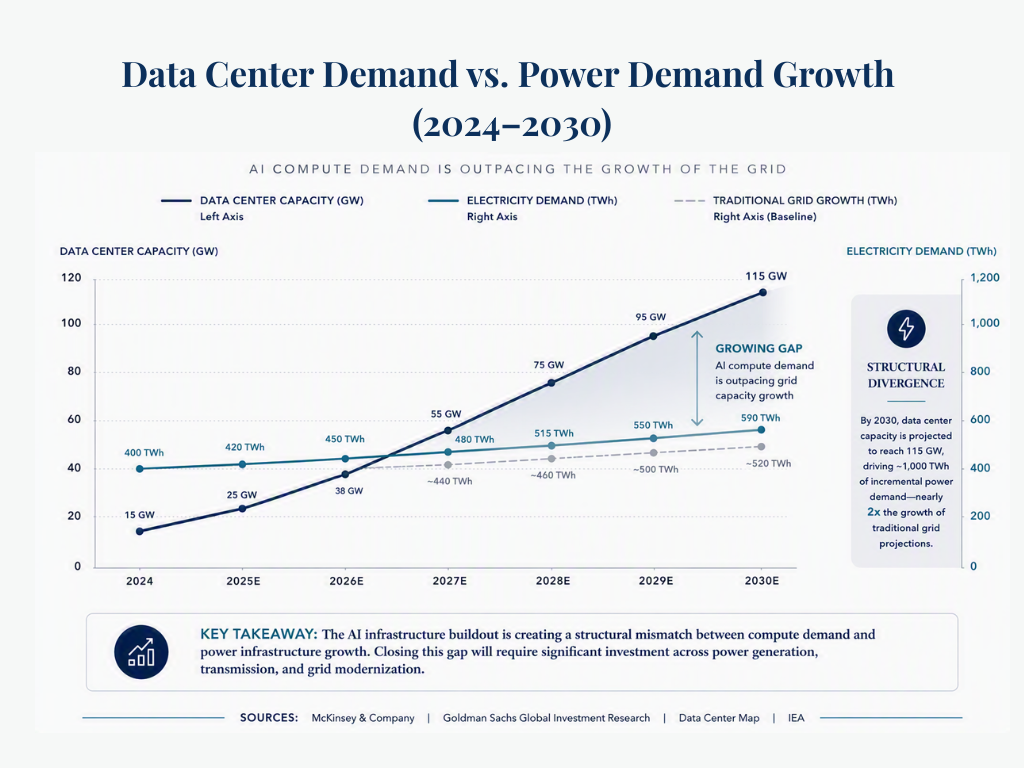
- Electricity is becoming the binding constraint: data center consumption is projected to more than double to about 945 TWh by 2030.
- Value flows through a broad chain of power, real estate, construction, equipment and financing providers.
- Underwriting discipline matters more than thematic enthusiasm, given overcapacity, obsolescence and monetization risks.
The AI Boom Is Bigger Than AI
When investors discuss artificial intelligence, attention naturally gravitates toward the most visible participants: model developers, semiconductor manufacturers, cloud platforms and application-layer software companies. But there is a more complete way to frame the opportunity.
Instead of asking, “Which AI company will win?” a more useful question is, “What must exist for every AI company to function?”
The answer extends far beyond software. AI requires data centers, electricity, semiconductors, networking infrastructure, cooling systems, fiber connectivity, land, construction capacity, financing and, increasingly, entire industrial ecosystems capable of supporting unprecedented computational demand.
This reframes the investment landscape. The most durable opportunity may not always sit with the companies building AI systems, but with those enabling them.
The International Energy Agency highlights the scale of this buildout: capital expenditure by the largest technology companies exceeded $400 billion in 2025 and is expected to rise by another 75% in 2026. The capital spending of just five technology companies is now larger than global investment in oil and natural gas production.1 Estimates keep climbing; after second-quarter earnings, Bank of America projected 2026 capex for Alphabet, Microsoft, Amazon and Meta at more than $860 billion.2
AI is increasingly an infrastructure cycle. And infrastructure expands the investable universe well beyond technology equities.
Source: S&P Global Ratings; International Energy Agency; McKinsey & Company.
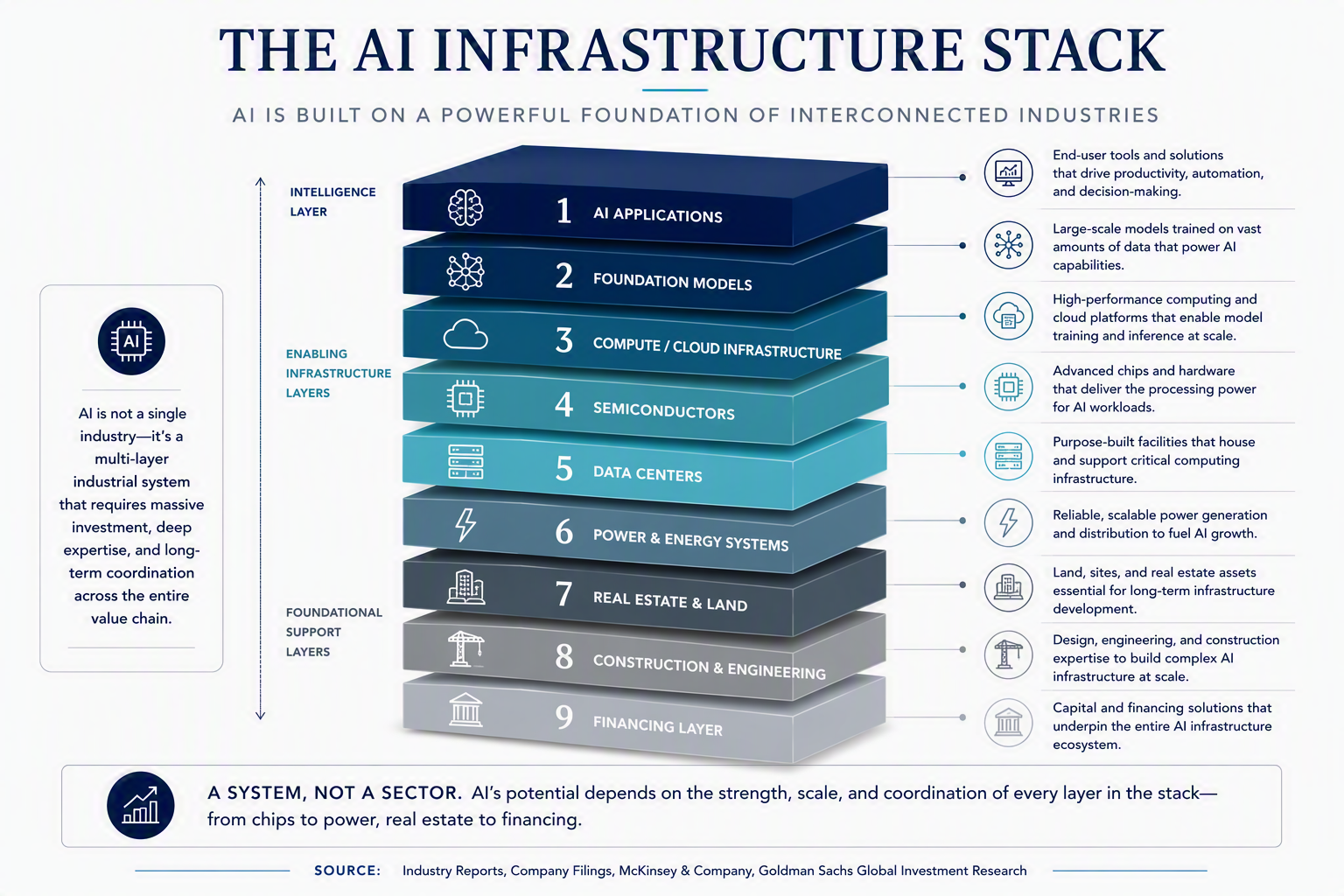
The First Layer: AI Companies
The most visible layer of the AI economy consists of companies developing and commercializing artificial intelligence systems. This includes:
- Foundation model developers
- Enterprise AI software providers
- Application-layer platforms
- AI agents and automation tools
- Robotics and physical AI systems
- Consumer AI products
These businesses may generate substantial long-term value, but they also face meaningful uncertainty. Key questions remain unresolved: Which models will dominate? How quickly will enterprise adoption scale? How rapidly will inference costs decline? Will AI applications commoditize? How durable will pricing power be in software?
These uncertainties make the application layer both attractive and highly competitive. By contrast, the infrastructure layer offers a different exposure profile. Rather than relying on the success of any single application, infrastructure benefits from aggregate demand across the entire ecosystem. If multiple AI platforms scale simultaneously, the underlying compute and energy systems benefit regardless of which application ultimately wins.
The Second Layer: Compute Infrastructure
Artificial intelligence is fundamentally constrained by compute. Training advanced models requires specialized accelerators, high-bandwidth networking, high-performance storage and increasingly dense computing environments. Inference—the ongoing execution of models at scale—adds a persistent and growing layer of demand.
As a result, data centers have evolved from a niche infrastructure segment into a core asset class of the AI economy. McKinsey estimates that global data center capacity demand could rise from about 82 gigawatts in 2025 to roughly 219 gigawatts by 2030 under its continued-momentum scenario, with AI workloads accounting for about 70% of the total.3
This is not solely a technology expansion. It is simultaneously:
- A real estate cycle
- A construction cycle
- An energy cycle
- A financing cycle
- An infrastructure cycle
The Critical Constraint: Power
The most binding constraint in the AI economy is increasingly not compute—it is electricity. AI data centers require vast and rising amounts of power, and the density of modern compute clusters is reshaping energy systems.
The IEA estimates that global data center electricity consumption was approximately 415 TWh in 2024, about 1.5% of global electricity use, and projects it to reach roughly 945 TWh by 2030 in its base case—more than doubling in six years and slightly exceeding Japan’s entire current electricity consumption.4
For investors, the implication is clear: AI is becoming an energy-driven investment theme. This creates demand across:
- Power generation
- Transmission infrastructure
- Substations and transformers
- Grid interconnection capacity
- Backup generation systems
- Energy storage
- Thermal management and cooling systems
The companies addressing these constraints may benefit regardless of which AI platforms ultimately dominate.
AI and the Transformation of Real Estate
Artificial intelligence is also redefining the economics of real estate. Traditional technology infrastructure was primarily office-based. AI infrastructure is industrial in nature. It requires:
- Large-scale land parcels
- Direct access to power infrastructure
- High-capacity fiber connectivity
- Industrial zoning and permitting flexibility
- Advanced cooling and water systems
- Proximity to transmission networks
As a result, land value is increasingly determined not by proximity to urban centers, but by access to energy and infrastructure. In this environment, power availability becomes a primary driver of real estate value. This is why industrial corridors, secondary markets and utility-adjacent land parcels are attracting increasing attention from institutional investors.
The geography of computing is becoming an investable variable.
Value Creation Extends Beyond the AI Companies
Every major technological cycle creates a broader ecosystem around the core innovation. The internet drove demand for fiber networks, data centers, telecommunications infrastructure and cloud computing. The smartphone era expanded semiconductor manufacturing, wireless infrastructure and digital advertising ecosystems. AI is following a similar pattern, but at significantly greater physical scale.
McKinsey estimates that data centers will require about $6.7 trillion in global investment by 2030 to keep pace with demand.3 This capital does not accrue solely to AI developers. It flows through a broad industrial chain:
- Semiconductor manufacturers
- Electrical and mechanical contractors
- Power developers and utilities
- Cooling and thermal systems providers
- Engineering and construction firms
- Data center operators
- Fiber and network providers
- Real estate owners
- Private credit and infrastructure lenders
This distribution of capital is central to the investment thesis. AI is not a single-sector opportunity—it is a multi-sector capital formation cycle.
AI as a Capital Multiplier
AI infrastructure investment is highly recursive. S&P Global Ratings expects the five largest cloud providers—Alphabet, Amazon, Meta, Microsoft and Oracle—to spend approximately $750 billion on capital expenditures in 2026, about 38% of their revenue, rising to $1 trillion by 2029.5
This level of investment creates a cascading effect. More compute requires more power infrastructure. More power infrastructure requires more equipment. More equipment requires more construction. More construction requires more land and real estate. And more infrastructure requires more financing. AI therefore functions as a capital multiplier across the broader economy.
“The most important investment opportunity created by AI may not be artificial intelligence itself.”
JLS Capital InsightsThe Financing Layer
The scale of infrastructure required to support AI necessitates substantial external financing. Data center development, energy infrastructure, semiconductor fabrication and grid expansion are all capital-intensive, long-duration projects. The shift is already visible: direct debt issuance by U.S. hyperscalers reached $115 billion in the first quarter of 2026 alone, compared with $70 billion in all of 2025.5
This creates a growing opportunity set across:
- Private credit
- Infrastructure funds
- Real estate capital
- Project finance
- Structured credit
- Private equity
- Institutional lending
As AI infrastructure scales, capital markets become an increasingly central component of the ecosystem. AI is therefore not only an equity story—it is also a credit and infrastructure finance story.
The Importance of Bottlenecks
A useful framework for understanding AI investment is to identify the binding constraint at each stage of the cycle. Historically, bottlenecks have shifted across:
- GPUs and compute hardware
- Memory and semiconductor supply
- Networking capacity
- Data center availability
- Power generation and grid access
- Permitting and construction capacity
- Financing availability
Investment opportunities tend to concentrate around the current constraint. This requires a shift in perspective: rather than asking what is growing, investors should ask what is limiting growth. That distinction often reveals less crowded and more durable opportunities.
Key Risks
The scale of opportunity is matched by the scale of capital intensity. Investors should not assume uniform benefit across the ecosystem. Key risks include:
- Overcapacity in data center buildout
- Rapid technological obsolescence
- Declining hardware costs
- Power and grid constraints
- Rising financing costs
- Customer concentration among hyperscalers
- Long development and payback cycles
- Regulatory and permitting delays
There is also a structural risk that AI infrastructure investment becomes overly concentrated among a small number of dominant technology firms. S&P Global has warned that heavy spending is limiting hyperscalers’ free cash flow, and that if expected cash flow improvements do not materialize, stretched balance sheets could pose a risk to their credit ratings.5
This creates a tension between rapid capital deployment and uncertain monetization. As a result, underwriting discipline becomes more important than thematic enthusiasm. The central question is not whether AI will matter—it already does. The question is which assets can generate attractive risk-adjusted returns while enabling that growth.
What Investors Should Monitor
Rather than focusing solely on model releases or application-layer developments, investors should track the underlying infrastructure cycle:
- Power availability – where new generation capacity can realistically be added
- Data center development – markets with land, fiber and permitting capacity
- Grid investment – transmission and distribution expansion
- Semiconductor supply chains – advanced manufacturing and packaging capacity
- Industrial construction – execution capacity for large-scale builds
- Private credit markets – financing conditions for infrastructure
- Real estate fundamentals – power-adjacent and infrastructure-linked land value
- AI monetization – whether end-use applications generate sufficient returns
These indicators provide a more grounded view of the cycle than headline technology narratives alone.
Artificial intelligence is often framed as a software revolution. In reality, it is also an industrial and infrastructure cycle. It requires physical systems, energy inputs, capital formation and large-scale construction. It reshapes real estate markets, accelerates energy demand and reconfigures capital allocation across industries.
This is why the AI opportunity extends far beyond the companies building models. The most important value creation may occur in the systems that make those models possible. In many cases, the most durable investments are not in the most visible layer of innovation—but in the infrastructure beneath it.
The JLS Perspective
At JLS Capital Group, we believe the most compelling investment opportunities often exist beneath the most visible narratives. Artificial intelligence is no exception.
The opportunity is not limited to identifying leading AI companies, but extends to understanding the broader ecosystem required to support them—and identifying where capital, infrastructure, real assets and operational expertise can generate durable value.
As AI reshapes the global economy, disciplined investors should look beyond the application layer and focus on the foundational systems enabling it.
Because the most important investment opportunity created by AI may not be artificial intelligence itself. It may be everything required for artificial intelligence to exist.
Sources
1. International Energy Agency, Key Questions on Energy and AI, April 2026. iea.org
2. Bank of America hyperscaler capex estimates, as reported by investingLive, 2026. investinglive.com
3. McKinsey & Company, “The cost of compute: A $7 trillion race to scale data centers,” April 28, 2025; “Data center demands” chart. mckinsey.com
4. International Energy Agency, Energy and AI, April 2025, as reported by Scientific American. scientificamerican.com
5. S&P Global Ratings, hyperscaler capex and credit analysis, 2026, as reported by FI Desk. fi-desk.com