
- How capital is structured matters as much as how much of it there is.
- Refinancing pressure, higher rates and intense lender competition are pushing deals toward tailored structures rather than templates.
- Preferred equity, mezzanine debt and junior capital are being combined into full capital stacks calibrated to each situation.
- GP-led continuation vehicles drove a record $121 billion in secondary volume in the first half of 2026.
- Creative structuring creates value only when it is grounded in disciplined underwriting.
Capital is not a commodity. Two investors can offer a company the exact same dollar amount and produce two entirely different outcomes—because how capital is structured matters as much as how much of it there is. A rigid term sheet can kill a good deal. A well-designed one can save a struggling company, fund a founder’s next chapter without diluting their control, or give a family office a way into an opportunity a standard check could never access.
That distinction—between capital as a commodity and capital as a tool—is becoming one of the defining themes in private markets. As standard financing structures fail to fit an increasingly complex set of situations, both borrowers and investors are turning to something less standardized: creative, tailored capital solutions built around the specific realities of a deal, not a template.
Source: Evercore H1 2026 Secondary Market Review; Berkadia, MBA CREF 2026 takeaways.
Why “Standard” Financing Increasingly Doesn’t Fit
For decades, the private capital playbook was relatively simple: senior debt from a bank, equity from a sponsor and a handful of well-worn structures in between. That playbook assumed conditions that no longer hold.
Refinancing has become a defining challenge. Nearly $1 trillion in U.S. commercial real estate loan maturities had to be addressed across 2025 and 2026, a wave that is as much about recapitalizations and changing ownership as it is about simple refinancing.1 Rates have not cooperated either: the Federal Reserve raised its target range to 3.75%–4.00% in September 2026, its first increase since 2023.2 And private credit, which stepped in as banks pulled back, has become more selective, with new issuance falling about 40% in the three months to May 2026, according to PitchBook data.3
At the same time, competition among lenders for quality assets remains intense. The result is a market where flexibility itself has become a competitive advantage. In one recent panel of commercial real estate lenders, the consensus was clear: creative structuring, speed and adaptability are crucial as competition for assets, borrowers and yield intensifies across every type of lender.4 The firms getting the best opportunities aren’t necessarily the ones with the most capital—they’re the ones willing to build a structure around a deal instead of forcing the deal into a structure.
The Rise of the Full Capital Stack
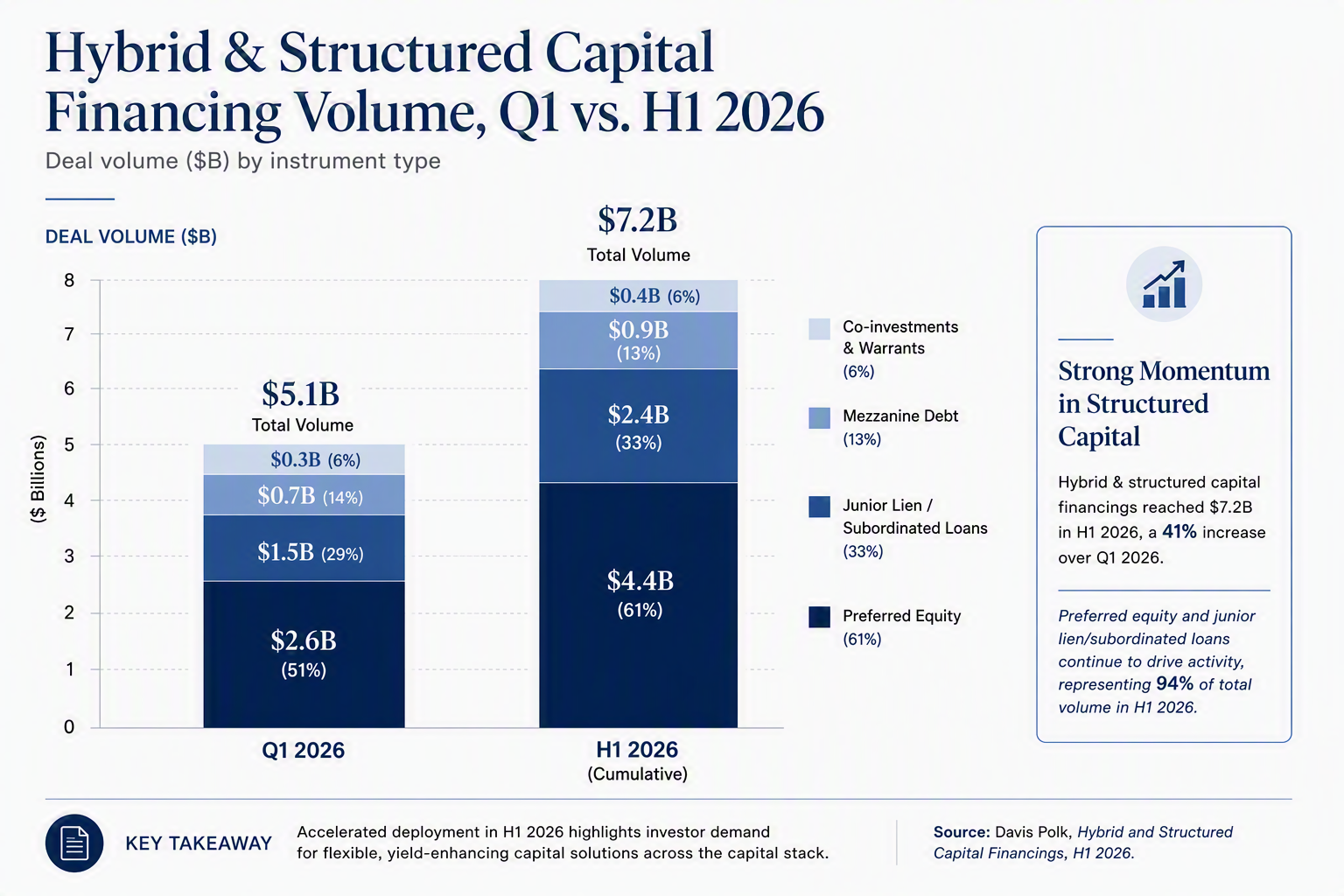
Nowhere is this more visible than in the growth of hybrid and structured capital. In the first half of 2026 alone, Davis Polk’s hybrid and structured capital practice advised on 36 transactions totaling more than $7.2 billion, spanning preferred equity, mezzanine debt, junior lien facilities and equity co-investments. Preferred equity accounted for more than $4.4 billion of that total, and the half-year figure already equaled more than 60% of the practice’s full-year 2025 volume of $11.4 billion.5
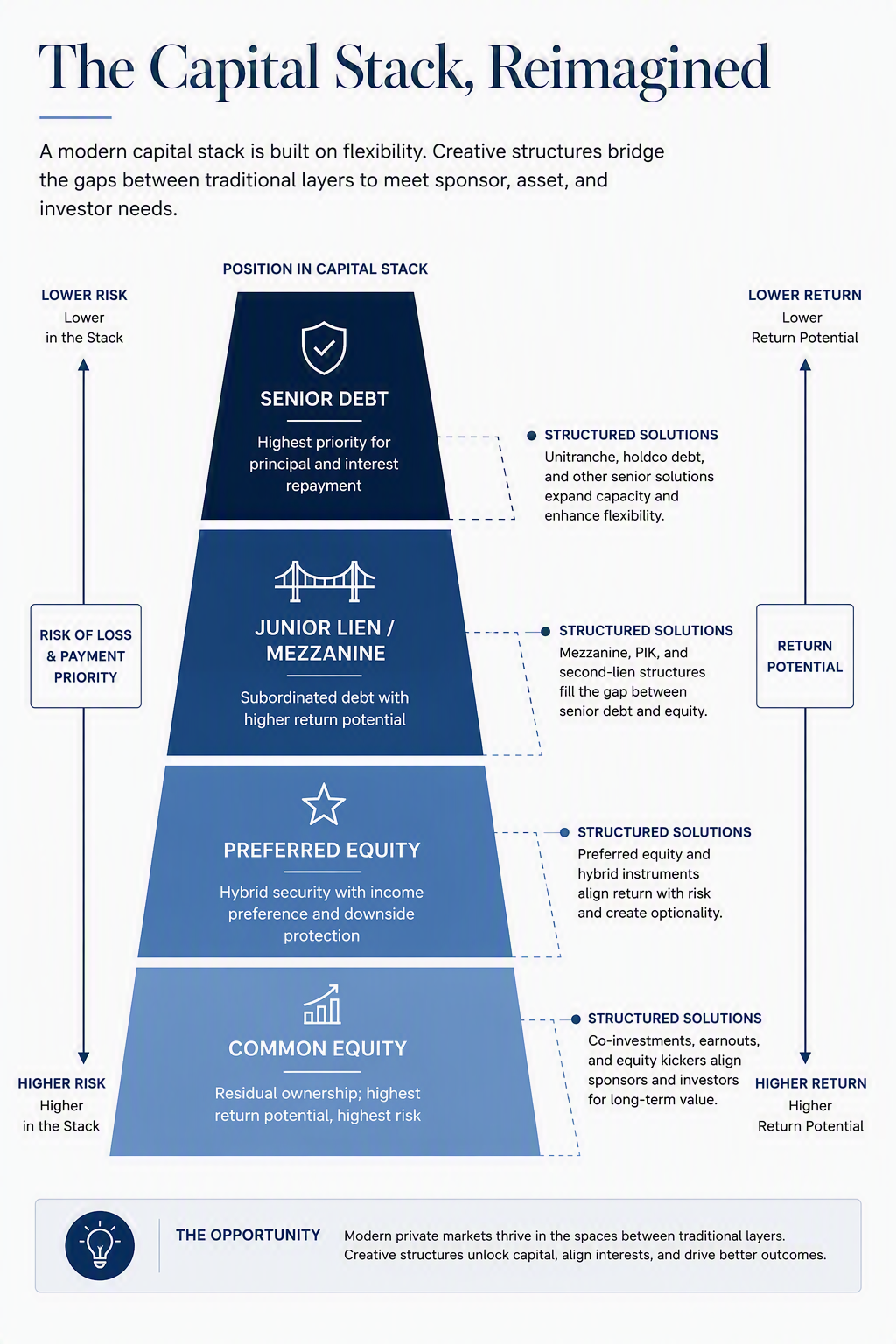
That pace reflects a broader shift: capital providers are no longer choosing between “debt” and “equity.” They’re assembling a full stack, layer by layer, calibrated to the specific risk and return profile a situation calls for.
Preferred equity has become particularly central to this shift. It sits between senior debt and common equity, offering downside protection closer to debt while preserving upside participation closer to equity—which makes it a natural fit when a sponsor needs capital that doesn’t trigger a full refinancing or dilute existing ownership. Mezzanine debt, meanwhile, continues to serve borrowers who need to bridge a gap that senior lenders won’t fill, without giving up the control a full equity raise would require.
The common thread across these structures isn’t complexity for its own sake. It’s precision—matching the shape of the capital to the shape of the risk.
“The best deal in the room rarely goes to whoever offers the most money. It goes to whoever offers the right structure.”
JLS Capital InsightsContinuation Vehicles: Creative Capital for the Exit Problem
Creative structuring isn’t limited to how new capital enters a company. It’s increasingly shaping how existing capital finds liquidity, too. GP-led continuation vehicles—funds structured to let a sponsor hold onto a high-conviction asset past its original fund’s life while giving existing investors an exit—have become one of the fastest-growing tools in private markets.
According to Evercore, secondary market volume reached approximately $121 billion in the first half of 2026, the strongest first half on record. GP-led transactions accounted for $65 billion, up from $48 billion a year earlier, while single-asset continuation vehicles rose 88% to about $34 billion.6
This matters beyond the secondaries market itself. It’s a signal of how private capital is solving a structural problem—sponsors wanting more time with their best assets, and LPs wanting liquidity without forcing a premature sale—through structure rather than compromise. Neither side has to accept a worse outcome. They just need a more creative one.
What Creative Capital Actually Solves
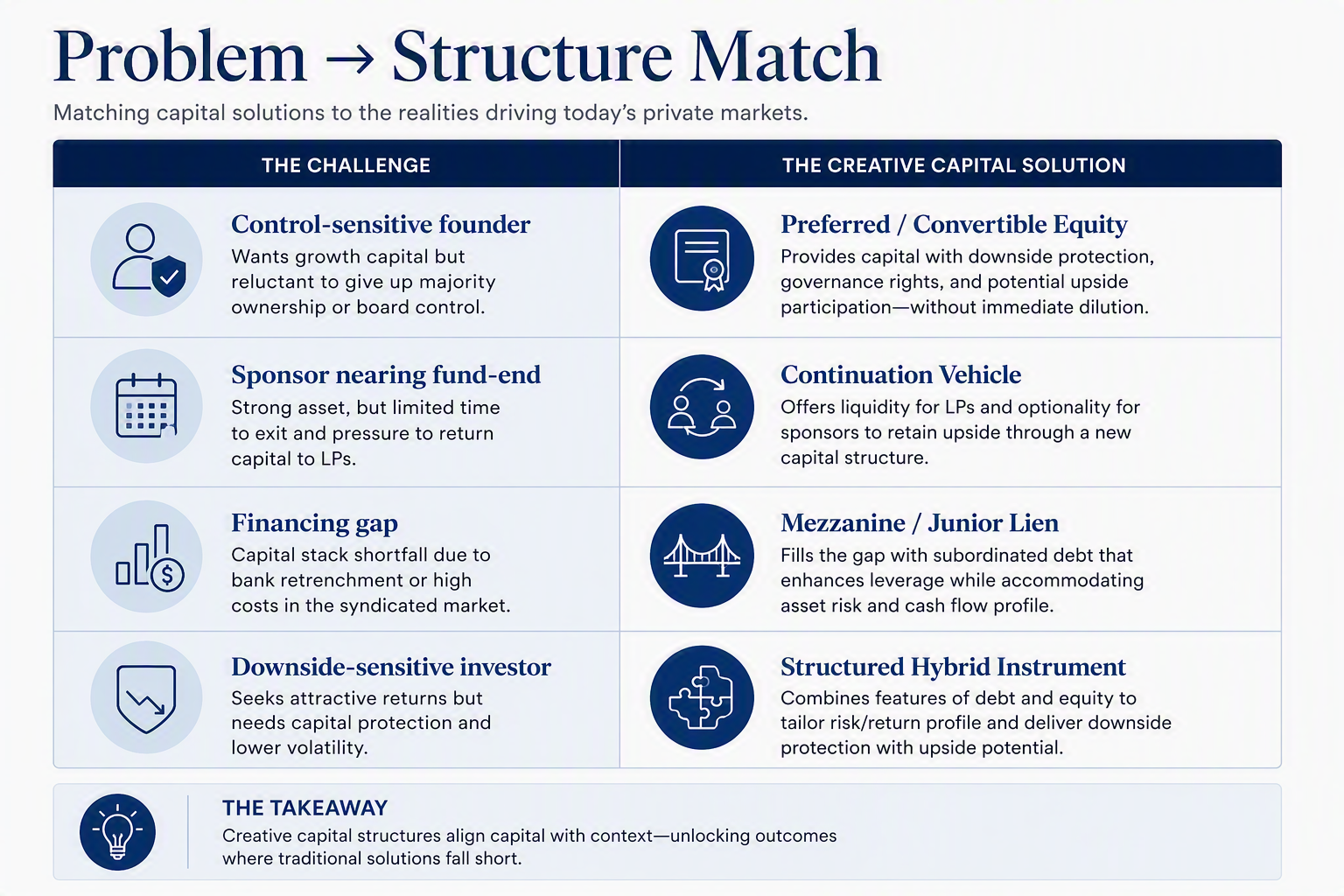
It’s worth being specific about what these structures unlock, because “creative capital” can sound like financial engineering for its own sake. In practice, it solves real, recurring problems:
- A founder who needs growth capital without giving up control – solved through preferred equity or convertible structures rather than a priced equity round.
- A sponsor who believes in an asset but has a fund nearing the end of its life – solved through a continuation vehicle rather than a forced sale.
- A borrower facing a gap between what a bank will lend and what a deal requires – solved through mezzanine or junior lien capital rather than losing the deal entirely.
- An investor who wants exposure to an opportunity but needs more downside protection than common equity provides – solved through structured or hybrid instruments built around that specific risk tolerance.
In every case, the underlying opportunity was real. What made it accessible was the willingness to structure capital around it, rather than walk away because it didn’t fit a standard template.
The Discipline Behind the Flexibility
There’s a risk worth naming here: creativity in capital structuring can become an excuse for poor underwriting if it isn’t grounded in real discipline. The firms succeeding in this environment aren’t the ones stretching structures to justify a deal they shouldn’t be in. They’re the ones using structure to express a clear view of risk—where they sit in the capital stack, what protects their downside and what actually has to happen operationally for the investment to work.
That distinction is the difference between financial engineering and genuine value creation. One is about making a bad deal look acceptable. The other is about making a good opportunity actually achievable for both sides.
The JLS Perspective
Creative capital solutions aren’t a workaround for when “real” financing doesn’t work. Increasingly, they are the real financing—the way sophisticated capital actually gets deployed in a market defined by refinancing pressure, longer hold periods and more complex situations than a standard playbook was ever built to handle.
The opportunities worth pursuing rarely arrive in a form that fits a template perfectly. What determines whether they get funded is whether the capital behind them is flexible enough, and disciplined enough, to meet them where they are.
That’s the standard we hold ourselves to at JLS Capital Group: capital structured with the same rigor as the underlying investment thesis, built around the deal in front of us rather than the deal we wish it were.
Sources
1. Berkadia, “MBA CREF 2026: Five Takeaways Shaping CRE Lending & Investment,” February 19, 2026. berkadia.com
2. NPR, “The Fed raises interest rates for the first time in over three years,” September 16, 2026. npr.org
3. CRE Daily, “Private Capital Leads CRE Investment as Credit Tightens,” citing PitchBook and CBRE data, 2026. credaily.com
4. Berkadia, “Private Credit in CRE: Liquidity, Competition, and Evolving Opportunities in 2026,” February 25, 2026. berkadia.com
5. Davis Polk, “Over $7.2 billion of hybrid and structured capital financings in H1 2026.” davispolk.com
6. Evercore, H1 2026 Secondary Market Review, July 2026. evercore.com