
The Hidden Economics Behind the World Cup
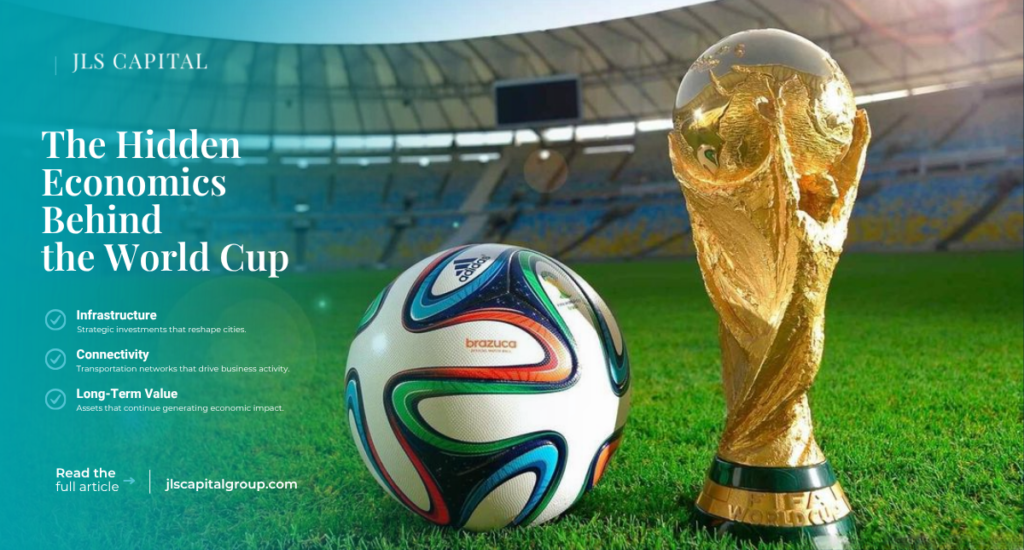
Key Takeaways
- The FIFA World Cup is one of the largest coordinated infrastructure and economic development initiatives undertaken by host nations.
- Transportation, airports, hospitality, utilities, and mixed-use development often generate a more enduring legacy than stadiums alone.
- Infrastructure investment frequently creates multiplier effects that benefit real estate, tourism, logistics, and regional business activity.
- The 2026 World Cup reflects a growing emphasis on modernizing existing assets rather than building entirely new ones.
- Investors can draw valuable lessons about long-term value creation, strategic capital allocation, and the importance of infrastructure in driving sustainable economic growth.
Why the world’s biggest sporting event has become one of the most powerful case studies in long-term investment, infrastructure development, and economic strategy.
Every Four Years, the World Watches the Matches. Investors Watch Something Else.
When billions of people tune in to watch the FIFA World Cup, they see goals, rivalries, and unforgettable moments on the field.
Governments, institutional investors, developers, infrastructure companies, airlines, hotel operators, and real estate investors see something very different.
They see airports.
Transportation networks.
Hotels.
Mixed-use developments.
Urban regeneration.
Tourism.
Foreign direct investment.
And perhaps most importantly, they see a once-in-a-generation opportunity to reshape how a country is perceived on the global stage.
The World Cup is often described as the largest sporting event in the world.
From an investment perspective, it is something even more significant:
It is one of the largest coordinated economic development projects ever undertaken by host nations.
The matches last one month.
The investments often influence economies for decades.
According to FIFA’s official tournament reporting, the 2022 World Cup in Qatar drew more than 3.4 million spectators across the tournament and reached a global television audience measured in the billions. That scale of attention is difficult to replicate through traditional marketing or tourism campaigns, which is why hosting becomes much more than a sporting exercise—it becomes a strategic economic and branding event.
| World Cup | Infrastructure Focus | Legacy Theme |
|---|---|---|
| Germany 2006 | Stadium modernization | Event-ready venues |
| South Africa 2010 | Rail & public transport | Urban mobility |
| Brazil 2014 | Airports & transit | Mixed outcomes |
| Russia 2018 | Regional development | Sustainable stadiums |
| Qatar 2022 | Smart city & metro systems | Urban transformation |
| 2026 North America | Upgrades & reuse | Sustainable modernization |
World Cup Infrastructure Investment & Legacy Timeline (2006–2026)
Beyond Sports: The Economics of Hosting a Global Event
Hosting a FIFA World Cup requires an extraordinary level of preparation.
Stadiums may be the most visible investments, but they represent only a fraction of the overall economic picture.
Host nations frequently invest in:
- Airports and aviation capacity
- Highways and public transportation
- Rail infrastructure
- Hotels and hospitality
- Telecommunications
- Utilities
- Public spaces
- Mixed-use districts
- Security systems
- Digital infrastructure
These projects are designed not only to accommodate millions of visitors but also to improve long-term economic competitiveness.
FIFA’s post-event reports on Qatar 2022, along with broader tourism and infrastructure research from the World Travel & Tourism Council and the International Air Transport Association, show how major events can place extraordinary pressure on transportation, hospitality, and urban systems while also accelerating upgrades that would otherwise take years to complete.
For many countries, hosting becomes an investment in national positioning.
It is not simply about filling stadiums.
It is about signaling capability, ambition, and readiness to the rest of the world.
Infrastructure as an Investment Strategy
Perhaps the most enduring legacy of the World Cup is infrastructure.
Modern economies depend on efficient movement—of people, goods, services, and information.
Major sporting events accelerate projects that might otherwise take decades to complete.
Germany’s 2006 World Cup is often cited in urban development and infrastructure discussions as a successful example of integrating tournament preparation into broader city planning. Rather than treating the event as an isolated spending cycle, Germany used the tournament to complement transportation improvements, public space enhancements, and stadium modernization within an already mature economy.
That approach stands in contrast to host nations that must build more from the ground up.
Qatar used the 2022 tournament as a catalyst for a broader national transformation. Beyond constructing stadiums, the country developed the Doha Metro, expanded Hamad International Airport, upgraded road networks, and accelerated projects aligned with Qatar National Vision 2030. FIFA infrastructure reports and official government announcements show that the tournament was embedded within a much larger national development agenda.
The lesson is not that every host should spend more.
It is that the most successful investments are those that remain valuable long after the final whistle.
That principle is consistent with what the OECD and World Bank have long emphasized in their research on infrastructure and economic development: the highest-return projects are those that improve productivity, connectivity, and long-term competitiveness rather than serving a single event.
| World Cup Host | Primary Infrastructure Focus | Key Investments | Long-Term Economic Objective |
|---|---|---|---|
| Germany 2006 | Stadium modernization and transport enhancements | Renovation and expansion of existing stadiums, upgrades to urban transport systems, rail connections, and event infrastructure. | Leverage existing assets, strengthen tourism, and create a lasting portfolio of world-class venues capable of hosting future international events. |
| South Africa 2010 | Public transportation and national connectivity | Gautrain rapid rail, BRT systems, airport expansions, road and rail improvements. | Improve urban mobility, stimulate tourism, increase economic inclusion, and modernize transport infrastructure for long-term development. |
| Brazil 2014 | Airports, urban mobility, and stadium development | Airport upgrades, BRT corridors, public transit projects, and stadium construction/renovation across 12 host cities. | Enhance city competitiveness, improve transportation capacity, support tourism growth, and modernize urban infrastructure. |
| Russia 2018 | Regional development and integrated transportation | New stadiums, rail improvements, airport modernization, urban redevelopment, and public space enhancements across 11 host cities. | Accelerate regional economic growth, strengthen domestic tourism, and create sustainable infrastructure for long-term urban development. |
| Qatar 2022 | Smart-city development and transit infrastructure | Doha Metro, Lusail Tram, Lusail City development, highways, utilities, and smart-city systems. [ | Diversify the economy beyond hydrocarbons, attract global investment, expand tourism, and create a knowledge-based urban economy. [ |
| North America 2026 (USA, Canada, Mexico) | Stadium modernization and sustainable infrastructure reuse | Stadium upgrades, digital technology, accessibility improvements, transit enhancements, airport capacity upgrades, and mobility projects. | Maximize economic impact through existing assets, reduce construction costs, improve regional connectivity, and create a sustainable mega-event model. |
Infrastructure Priorities and Long-Term Economic Objectives Across FIFA World Cup Host Nations (2006–2026)
Real Estate Often Becomes the Quiet Winner
Large-scale infrastructure investments frequently reshape surrounding real estate markets.
Improved transportation increases accessibility.
Accessibility attracts businesses.
Businesses attract workers.
Workers create demand for housing, retail, healthcare, logistics, and commercial development.
This multiplier effect has been observed repeatedly across major global events and is well documented in research from the World Bank, the OECD, and Brookings Institution studies on urban development and transit-oriented growth.
Neighborhoods surrounding transportation hubs often experience increased investment activity.
Hospitality assets benefit from tourism growth.
Mixed-use developments emerge around newly improved districts.
Industrial logistics expand to support increased commercial activity.
In many cases, the most valuable assets are not the stadiums themselves—but the ecosystems created around them.
This principle extends far beyond sporting events.
It reflects how infrastructure investment influences long-term real estate fundamentals and why connectivity remains one of the most important drivers of value creation in urban markets.
The Business of Global Visibility
Hosting the World Cup is also an exercise in national branding.
Countries compete not only for visitors but for future investment.
The event places host cities before billions of viewers, offering an opportunity to showcase infrastructure, innovation, tourism, and economic stability.
For businesses, this visibility can influence international perception.
For investors, perception often affects capital flows.
While visibility alone cannot overcome weak fundamentals, it can amplify strong ones.
Countries that pair global exposure with sound economic policy, business-friendly environments, and strategic infrastructure investments are often better positioned to attract foreign direct investment after the tournament concludes.
That relationship between visibility and capital formation is consistent with OECD foreign direct investment data, World Bank research on investment climate, and WTO analysis of tourism and trade flows. In other words, the World Cup does not create economic credibility on its own—but it can magnify credibility that already exists.
The 2026 World Cup: A Different Economic Model
The upcoming FIFA World Cup, hosted jointly by the United States, Canada, and Mexico, represents a different approach from previous tournaments.
Unlike many past hosts, the three countries already possess extensive transportation networks, established hospitality industries, and numerous stadiums capable of hosting international events.
Rather than focusing on large-scale stadium construction, much of the investment is expected to center on modernization, technology, transportation enhancements, public safety, and visitor experience.
This reflects an important evolution.
Mega-events are increasingly becoming opportunities to optimize existing infrastructure rather than simply build new assets.
That shift is visible in FIFA’s 2026 planning materials, U.S. Soccer Federation updates, and official host-city infrastructure announcements, which emphasize upgrades, coordination, and operational readiness over entirely new construction.
For investors, this shift reinforces a broader trend toward maximizing returns on existing capital through modernization and operational improvement.
Lessons for Investors
The World Cup offers several lessons that extend well beyond sports.
1. Infrastructure creates long-term value.
Major transportation and public works projects often outlast economic cycles and become catalysts for private investment.
2. Real estate follows connectivity.
Improved accessibility continues to influence residential, commercial, hospitality, and industrial demand.
3. Events accelerate investment.
Deadlines force governments and private partners to execute projects that might otherwise remain on hold for years.
4. Global perception influences capital.
Branding, reputation, and international visibility increasingly shape tourism, foreign investment, and business confidence.
5. Legacy matters more than the event itself.
The most successful investments are those that continue generating economic value long after visitors return home.
These lessons are consistent with infrastructure productivity research from McKinsey & Company, capital projects analysis from PwC, and sports business studies from Deloitte, all of which point to the same conclusion: the highest-value outcomes come from disciplined execution, not just headline-grabbing spending.
Looking Beyond the Tournament
The World Cup reminds us that some of the world’s largest investment opportunities begin with a deadline rather than a market cycle.
A stadium may host seven matches.
A transportation network may serve millions of people for decades.
A mixed-use district may transform an entire neighborhood.
An airport expansion may support generations of economic growth.
Viewed through this lens, the tournament becomes something much larger than sport.
It becomes a case study in how strategic capital allocation, infrastructure investment, and long-term planning can reshape cities, regions, and national economies.
The broader lesson is simple: the greatest value is often created not by the event itself, but by the assets and partnerships that endure long after the spotlight moves on.
The JLS Perspective
At JLS Capital Group, we believe lasting value is rarely created by a single event—it is created by the infrastructure, partnerships, and strategic investments that continue delivering economic impact long after the headlines fade. Whether evaluating real estate, private equity, or structured capital opportunities, we believe the same principle applies: the most successful investments are those built on enduring fundamentals, disciplined execution, and a long-term vision for growth.
John Jezzini
Founder & CEO

JLS Capital is a Beverly Hills–based private investment firm specializing in bespoke debt structures, private equity, and real estate investments.
Quick Links
Legal & Support
- Privacy Policy
- Terms of Service
- Contact Us
Newsletter
Subscribe to receive our latest market analysis and exclusive firm updates.
Copyright © 2026 JLS Capital. All rights reserved.