
- The most important signals are often the structural changes beneath the market, not the headline forecasts.
- Underwrite every project against a “higher for longer” cost of capital, and treat refinancing risk as seriously as acquisition risk.
- For data centers and the wider AI economy, power availability is becoming the decisive location factor.
- Insurance, construction costs and adaptability now shape project economics as much as rent growth.
- Liquidity and disciplined underwriting are strategic advantages in a market where the quality gap keeps widening.
Every year, real estate investors are given the same list of things to watch: interest rates, cap rates, home prices, construction costs and market forecasts. But the most important signals are rarely the ones dominating the headlines.
The better question is not “What will the market do this year?” It is “What is changing underneath the market that could affect value over the next five to ten years?”
That distinction matters, because developers are no longer operating in an environment where cheap capital can compensate for weak fundamentals. Investors are underwriting more carefully. Lenders are becoming more selective. Insurance costs are reshaping project economics. Artificial intelligence is creating entirely new infrastructure demand. Manufacturing investment is changing regional economies. And population migration continues to redirect housing and commercial demand across the United States.
The result is a market where discipline, location, flexibility and execution matter more than ever. For developers and investors, these are the signals worth watching.
Source: Berkadia, MBA CREF 2026 takeaways; Green Street Commercial Property Price Index (June 2026); International Energy Agency.
The Cost of Capital Is Still the Starting Point
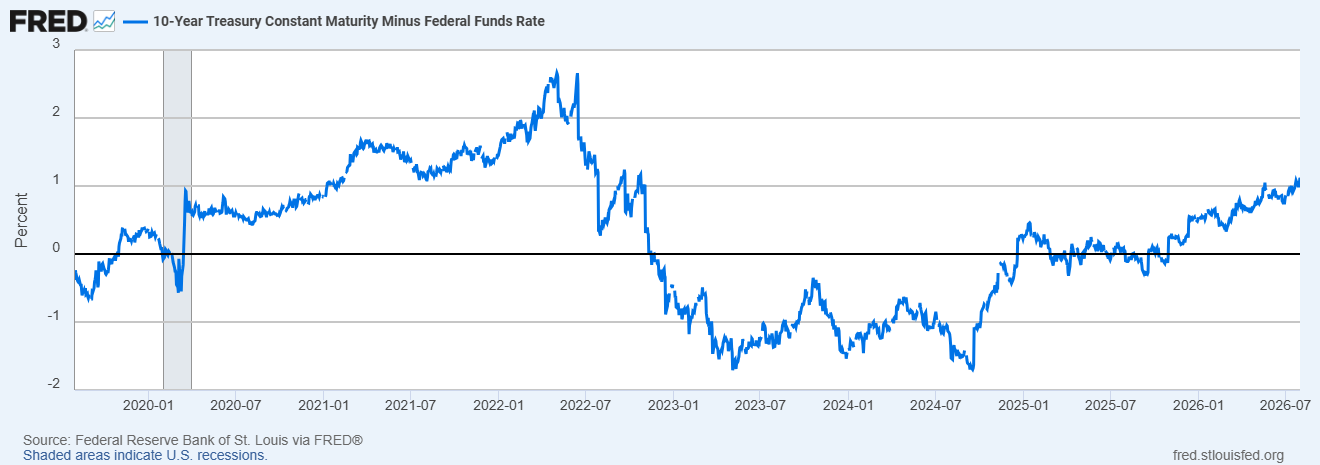
Interest rates remain one of the most important variables in real estate, and the direction of travel has not been as friendly as many expected. In September 2026, the Federal Reserve raised its target range to 3.75%–4.00%, its first increase since 2023.1
But simply watching the federal funds rate is no longer enough. Investors should also be watching:
- Treasury yields
- Commercial lending standards
- Credit spreads
- Debt-service coverage requirements
- Loan maturities
- Refinancing activity
The reason is simple. Real estate values are heavily influenced by the cost and availability of capital. When financing becomes more expensive, projects that previously looked attractive can quickly become difficult to justify. Developers therefore need to underwrite projects against multiple financing scenarios—not simply the base case.
A project that works only if rates fall quickly is not necessarily a strong project. A project that remains viable under multiple interest rate scenarios is far more resilient. The most sophisticated investors are increasingly asking, “What happens if capital stays expensive longer than expected?” That question can reveal more than any market forecast.
Refinancing Risk May Matter More Than Acquisition Risk
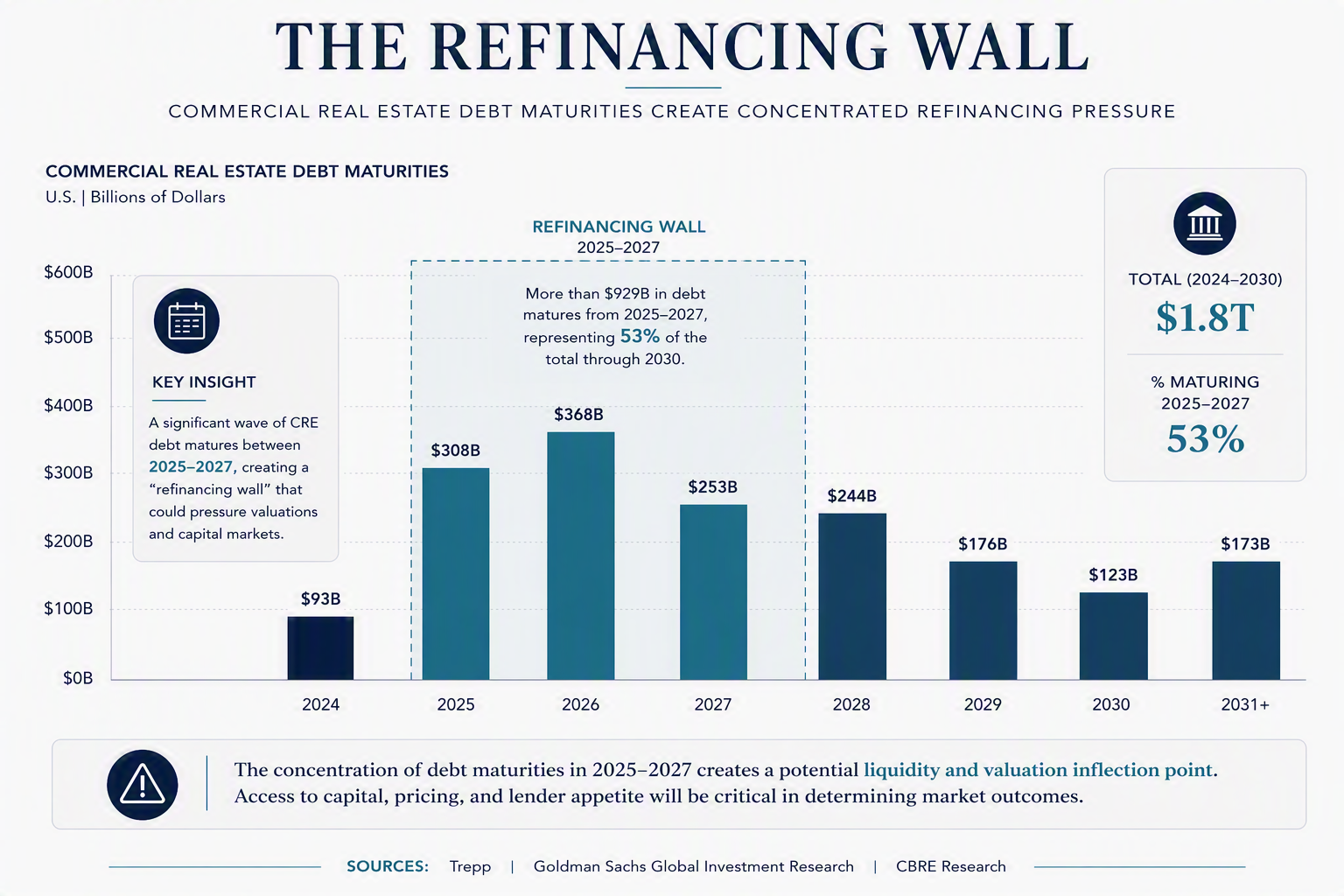
One of the most important developments in commercial real estate is the growing importance of refinancing. A property can perform well operationally and still face financial pressure if its debt matures in an unfavorable environment. Nearly $1 trillion in U.S. commercial real estate loans had to be addressed across 2025 and 2026, a wave that involves recapitalizations, ownership changes and repricing as much as simple refinancing.2
That creates a different kind of risk. Not “Can we buy this asset?” but “Can we refinance it when the current loan expires?” This is particularly important for assets financed during the low-rate period. Developers and owners should be evaluating:
- Current debt maturity schedules
- Loan-to-value ratios
- Interest rate exposure
- Floating-rate debt
- Extension options
- Debt-service coverage
- Required equity contributions
For investors, refinancing risk can create both challenges and opportunities. Some owners may need to sell assets they would otherwise prefer to hold. Others may require recapitalization. Still others may seek structured capital or private credit solutions—though private credit itself has become more selective, with new issuance falling about 40% in the three months to May 2026, according to PitchBook data.3 That means capital structure itself can become an investment opportunity.
Data Centers and the AI Infrastructure Economy
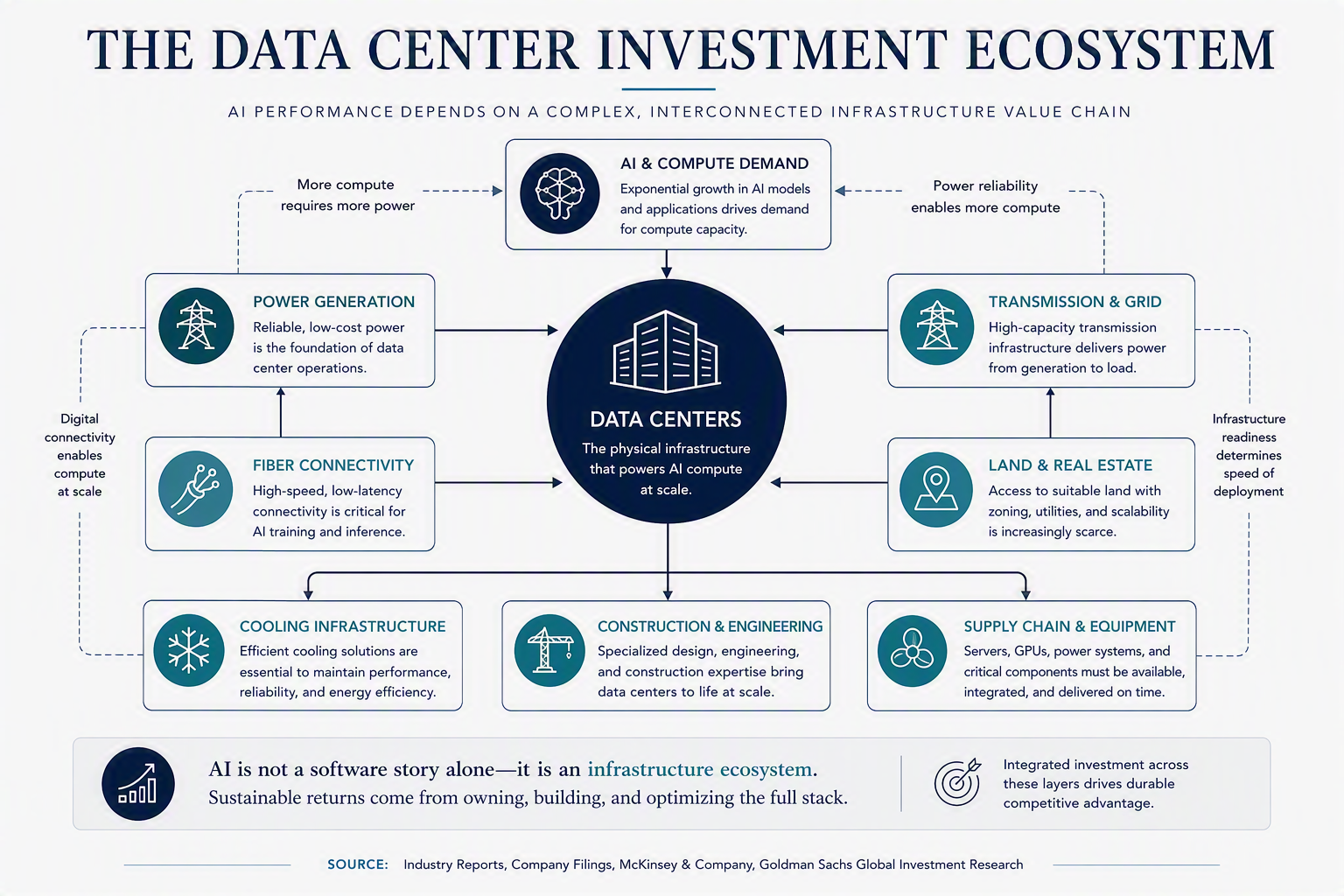
The growth of artificial intelligence has changed the economics of data centers. The conversation used to focus primarily on computing capacity. Now it increasingly revolves around power. The International Energy Agency projects that global data center electricity consumption will rise from about 415 TWh in 2024 to roughly 945 TWh by 2030.4
Data center development is therefore becoming closely tied to:
- Power availability
- Grid capacity
- Transmission infrastructure
- Cooling systems
- Land
- Fiber connectivity
- Water availability
- Permitting
This creates a major shift in how investors evaluate locations. A market may have inexpensive land, but if it cannot provide reliable power at scale, that land may have limited strategic value for data center development. The most valuable infrastructure may therefore sit outside the data center itself—in power generation, transmission, fiber, industrial land and energy infrastructure. That creates investment opportunities across a much broader ecosystem.
The AI Boom Is Creating More Real Estate Demand Than AI Office Space
Artificial intelligence is often discussed as a technology investment story. For real estate investors, it is increasingly an infrastructure story. McKinsey estimates that data centers will require about $6.7 trillion in global investment by 2030 to keep pace with demand.5 AI is creating demand for:
- Data centers
- Power infrastructure
- Industrial facilities
- Advanced manufacturing
- Semiconductor facilities
- Logistics
- Specialized construction
- Research facilities
That means investors should look beyond the companies developing AI models. The more interesting question may be “What physical infrastructure does the AI economy require?” This is one reason markets with access to power, land, fiber, industrial infrastructure and skilled labor are attracting increasing attention. AI is not simply changing how businesses work. It is changing where capital needs to be deployed.
Insurance Is Becoming a Core Underwriting Variable
For years, insurance was often treated as a routine operating expense. That is changing. In markets exposed to hurricanes, wildfires, flooding and other climate-related risks, insurance costs have become a major driver of property economics—and a volatile one.
The swings illustrate why. According to Trepp data, the median increase in insurance costs for securitized Florida multifamily properties peaked at 42.1% in 2023, then reversed to a 6.2% decline in 2025, while costs elsewhere in the country still rose.6 Property insurance pricing has softened in 2026, but brokers warn the cycle could turn again as early as late 2026 or early 2027, and liability coverage remains tight in states such as Florida and Georgia.7
Developers and investors should be watching:
- Premium growth
- Deductibles
- Availability of coverage
- Reinsurance markets
- Building codes
- Property-level risk
- Geographic concentration
A property can have attractive rent growth and strong occupancy while still becoming less attractive if insurance costs rise faster than revenue. That means insurance should increasingly be modeled as a core component of investment underwriting, not an afterthought. The question is no longer simply “What is the property’s NOI?” It is “How resilient is that NOI after financing, insurance, taxes and operating costs?”
Construction Costs Are Changing What Gets Built
Construction costs remain one of the most important variables affecting development feasibility. But the issue is not simply whether costs rise or fall. It is whether the economics of new construction still make sense relative to existing assets. Developers are increasingly comparing build vs. buy, develop vs. redevelop, ground-up vs. adaptive reuse, and new construction vs. renovation.
This is creating opportunities for investors capable of identifying assets where existing structures can be repositioned more efficiently than building from scratch. Adaptive reuse is particularly interesting in markets where older properties occupy strategically valuable locations, especially as office values remain about a third below their 2022 peak.8 The building may be obsolete. The land may not be. That distinction can create significant investment opportunity.
“The building may be obsolete. The land may not be.”
JLS Capital InsightsRegional Markets and the Manufacturing Economy
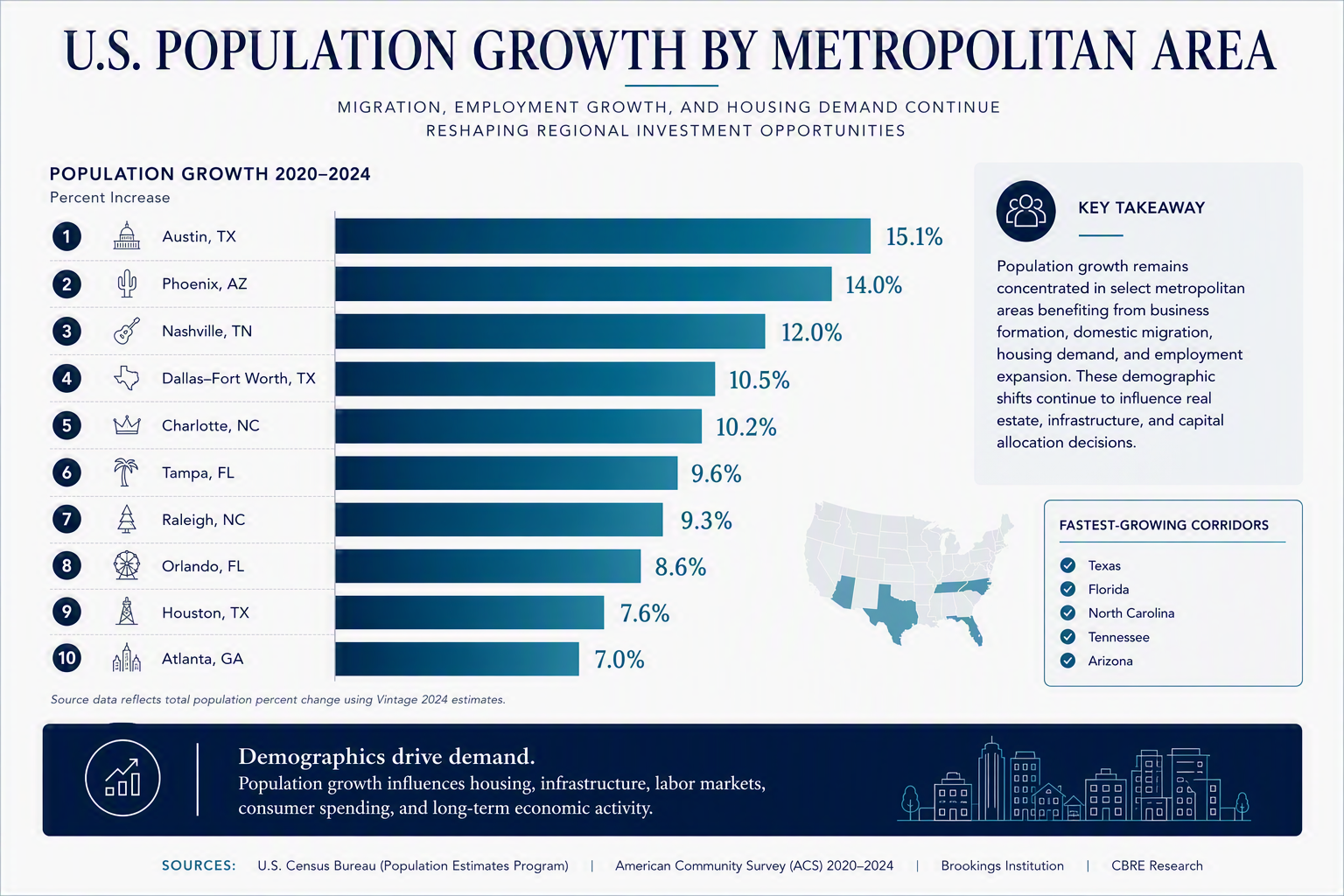
The U.S. investment map continues to evolve. Population growth, business relocation, manufacturing investment and infrastructure development are creating new economic centers outside traditional gateway cities. Between 2020 and 2025, the U.S. South grew by 6.0%, nearly double the national rate of 3.1%.9
Investors should pay attention to markets where several forces overlap:
- Population growth
- Job creation
- Corporate investment
- Infrastructure spending
- Housing demand
- Industrial expansion
- University or research ecosystems
The important point is that population growth alone is not enough. The strongest markets tend to combine people + jobs + capital + infrastructure. That combination creates a much more durable demand base.
Manufacturing Is Reshaping Local Economies
Reshoring and domestic manufacturing investment are creating another structural shift across semiconductors, electric vehicles, battery manufacturing, advanced industrial production, defense and energy infrastructure. In Phoenix alone, TSMC has raised its planned U.S. investment to $165 billion, including six fabrication plants, two advanced packaging facilities and an R&D center.10
These investments do not exist in isolation. A major manufacturing facility creates secondary demand for suppliers, warehousing, housing, restaurants, healthcare, transportation and business services. For real estate investors, the factory may be only the beginning. The larger opportunity can be the ecosystem that develops around it.
This is why investors should track major corporate capital expenditures—not simply real estate transactions. A company’s investment decision today can become a region’s real estate demand tomorrow.
Liquidity Is Becoming an Investment Advantage
One of the most important lessons from recent market cycles is that liquidity is not simply defensive. It is strategic. When capital is abundant, optionality can seem unnecessary. When markets become dislocated, liquidity can become one of the most valuable assets an investor owns. It allows investors to:
- Acquire distressed assets
- Fund capital improvements
- Support portfolio companies
- Take advantage of mispricing
- Avoid forced sales
- Move quickly when competitors cannot
This is especially important in a market where refinancing needs, construction costs and asset repricing can create opportunities unexpectedly. The best investors do not simply ask, “What should we buy?” They also ask, “How much flexibility should we preserve so we can act later?”
The Quality Gap Is Getting Wider
Perhaps the biggest theme developers and investors should watch this year is the growing separation between high-quality and low-quality assets. The market is becoming less forgiving. Strong assets attract capital. Weak assets require discounts. In office, for example, PwC and the Urban Land Institute report that top-tier buildings in major markets are capturing record rents even as overall valuations remain far below pre-pandemic peaks.11
The difference increasingly comes down to location, tenancy, cash flow, physical quality, financing, management and adaptability. This creates a more selective investment environment. It also creates opportunity, because when the market stops treating every asset as equal, investors with strong underwriting capabilities can identify value that broad market statistics may hide.
Questions to Ask Before Committing Capital
For Developers, Before Breaking Ground
- Where is demand actually coming from? Population, jobs, corporate investment, government infrastructure or technology?
- What happens if financing stays expensive? Does the project still work?
- What happens if construction costs remain elevated? Is there enough margin?
- What happens if the market changes? Can the asset be repositioned?
- What infrastructure does the project depend on? Power, water, transportation or fiber?
- What happens after stabilization? Who will buy or finance the asset?
These questions do not eliminate risk. They make risk visible.
For Investors, Before Deploying Capital
- Is the demand structural or cyclical?
- Is the market gaining population and jobs?
- Is capital flowing into the region for fundamental reasons?
- Does the asset have multiple potential uses?
- Can the business survive a higher-cost-of-capital environment?
- Is the balance sheet resilient?
- Is there a realistic exit strategy?
- What happens if the base case is wrong?
The last question may be the most important: what happens if we’re wrong? Great underwriting is not about predicting the future perfectly. It is about building investments that remain viable when the future does not unfold exactly as expected.
Looking Beyond This Year
The most important investment trends rarely begin as investment trends. They begin as economic changes. People move. Companies relocate. Technology changes infrastructure requirements. Governments invest in roads, power and manufacturing. Consumers change how they live and work. Real estate follows, and capital follows.
Developers who recognize those changes early can position themselves before the market fully reprices them. Investors who understand the underlying economics can distinguish temporary enthusiasm from durable demand. That is ultimately what this year’s market will reward. Not prediction. Preparation.
The JLS Perspective
At JLS Capital Group, we believe the best investment decisions begin with understanding what is changing beneath the surface. Interest rates matter, but so do demographics. Technology matters, but so does infrastructure. Market pricing matters, but so does the quality of the underlying asset.
Our approach is grounded in disciplined underwriting, operational perspective and long-term value creation across private equity, real estate and structured capital. Because the most attractive opportunities are often created before they become obvious.
Sources
1. NPR, “The Fed raises interest rates for the first time in over three years,” September 16, 2026. npr.org
2. Berkadia, “MBA CREF 2026: Five Takeaways Shaping CRE Lending & Investment,” February 19, 2026. berkadia.com
3. CRE Daily, “Private Capital Leads CRE Investment as Credit Tightens,” citing PitchBook and CBRE data, 2026. credaily.com
4. International Energy Agency, Energy and AI, April 2025, as reported by Scientific American. scientificamerican.com
5. McKinsey & Company, “The cost of compute: A $7 trillion race to scale data centers,” April 2025; “Data center demands” chart. mckinsey.com
6. CRE Daily, “Florida Multifamily Insurance Costs Fall 6.2% in 2025,” citing Trepp data, 2026. credaily.com
7. The Baldwin Group, “2026 Real Estate – Multifamily Mid-Year State of the Market,” July 29, 2026. baldwin.com
8. Green Street Commercial Property Price Index, June 2026, as reported by CRE Daily. credaily.com
9. U.S. Census Bureau, Vintage 2025 Population Estimates, June 25, 2026. census.gov
10. Arizona Technology Council, “TSMC to Scale Up to a GIGAFAB Cluster in Arizona.” aztechcouncil.org
11. PwC and Urban Land Institute, Emerging Trends in Real Estate® 2026, press release, November 2025. pwc.com