
- Capital is abundant, but it is concentrating in sectors driven by structural change rather than cyclical momentum.
- Limited partners increasingly reward sector specialists with the operational fluency to improve the businesses they back.
- Digital infrastructure is blurring the line between real estate and infrastructure, and infrastructure fundraising hit a record in 2025.
- Healthcare and industrials remain favored for their defensive demand, fragmentation and links to reshoring and the AI buildout.
- Private credit is the financing layer connecting nearly every one of these sectors.
Private markets are not short on dry powder. Dealmakers, allocators and family offices are sitting on substantial reserves of capital, and after several sluggish years, transaction activity is accelerating again: global buyout deal value rose 44% in 2025 to $904 billion, according to Bain & Company.1 But abundance is not the same as opportunity. The real story of 2026 is not how much capital exists—it’s where that capital is choosing to concentrate, and why the sectors attracting it look different from the ones that defined the last decade.
For years, private equity’s playbook rewarded broad exposure: buy good companies, use leverage, wait for multiples to expand. That formula is largely spent. Interest rates reset the math, exits slowed and generalist strategies stopped generating the returns LPs had come to expect. With buyout borrowing costs around 8% to 9%, Bain concludes that attractive returns now require significantly more operational improvement and revenue growth.1 What’s replacing the old playbook is something more deliberate—capital that follows structural change rather than cyclical momentum, and managers who can prove they understand an industry rather than simply write a check into it.
Understanding where that capital is moving is no longer a niche concern for institutional allocators. It’s a signal for founders deciding who to partner with, operators deciding where to build and investors trying to separate durable trends from temporary noise.
Source: Bain & Company Global Private Equity Report 2026; BCG Infrastructure Strategy 2026; Hologic and Blackstone announcements.
Specialization Has Become the New Alpha
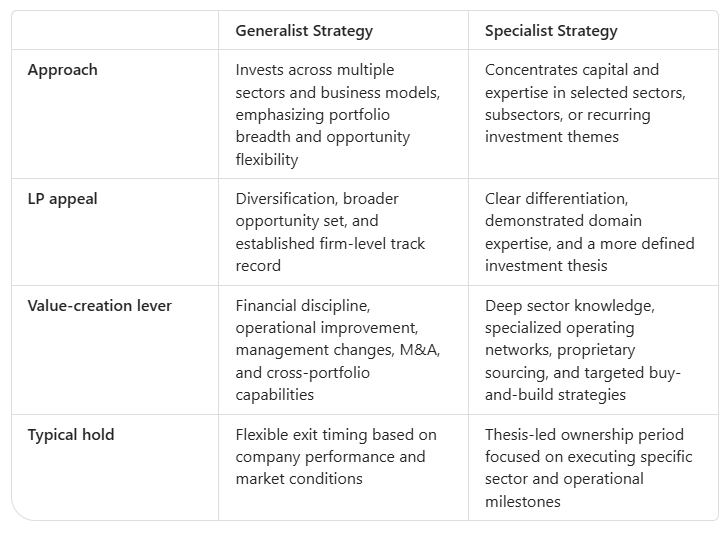
The single biggest shift in private markets isn’t a sector at all—it’s a strategy. Limited partners are increasingly rewarding managers who go deep into one industry rather than spreading capital across many. A generalist fund promises diversification. A specialist fund promises something LPs now value more: the operational fluency to identify inefficiencies a generalist would miss, and the credibility to fix them.
This matters because it reframes the entire question of “which sectors to watch.” It’s not simply about which industries are growing. It’s about which industries reward operators who understand them from the inside—supply chains, regulatory nuance, unit economics, customer behavior—because that is where the next decade of value creation will actually be built.
Digital Infrastructure Is Rewriting the Rules of Real Assets
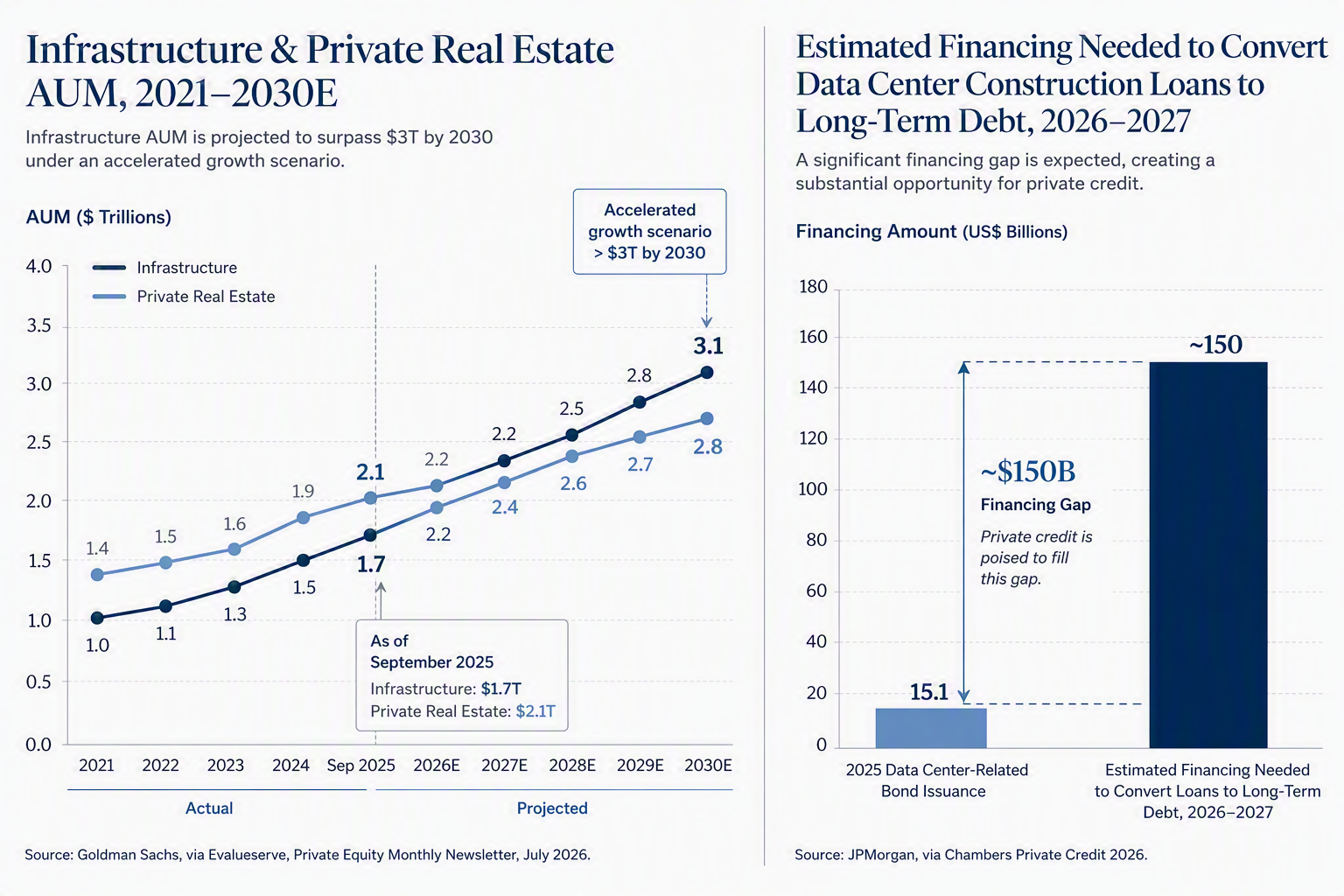
No sector illustrates the new capital logic better than digital infrastructure. The buildout of AI-driven data centers has become one of the largest capital commitments in corporate history. S&P Global Ratings expects the five largest cloud providers to spend about $750 billion on capital expenditures in 2026, rising to $1 trillion by 2029, and McKinsey estimates data centers will require about $6.7 trillion in global investment by 2030.23 That spending is now colliding with the limits of traditional financing, pushing a growing share of the funding gap toward private credit and infrastructure funds.
The numbers illustrate the shift. Infrastructure funds raised a record $211 billion in 2025, up 60% from the previous year, and private infrastructure assets under management reached $1.6 trillion, about 10% of all private market assets.4 Perhaps most telling is that the line between “infrastructure” and “real estate” is dissolving. A data center is simultaneously a building, a power contract, a network asset and a piece of critical technology infrastructure—which means the investors best positioned to win in this sector are the ones comfortable underwriting all four at once.
This is the kind of sector JLS Capital Group pays close attention to: not because it’s fashionable, but because it sits at the intersection of real assets, operational complexity and long-duration capital—exactly where disciplined, patient investors tend to outperform.
“Capital has never been more abundant. Yet it has rarely been this selective about where it goes.”
JLS Capital InsightsHealthcare Remains the Market’s Quiet Compounder
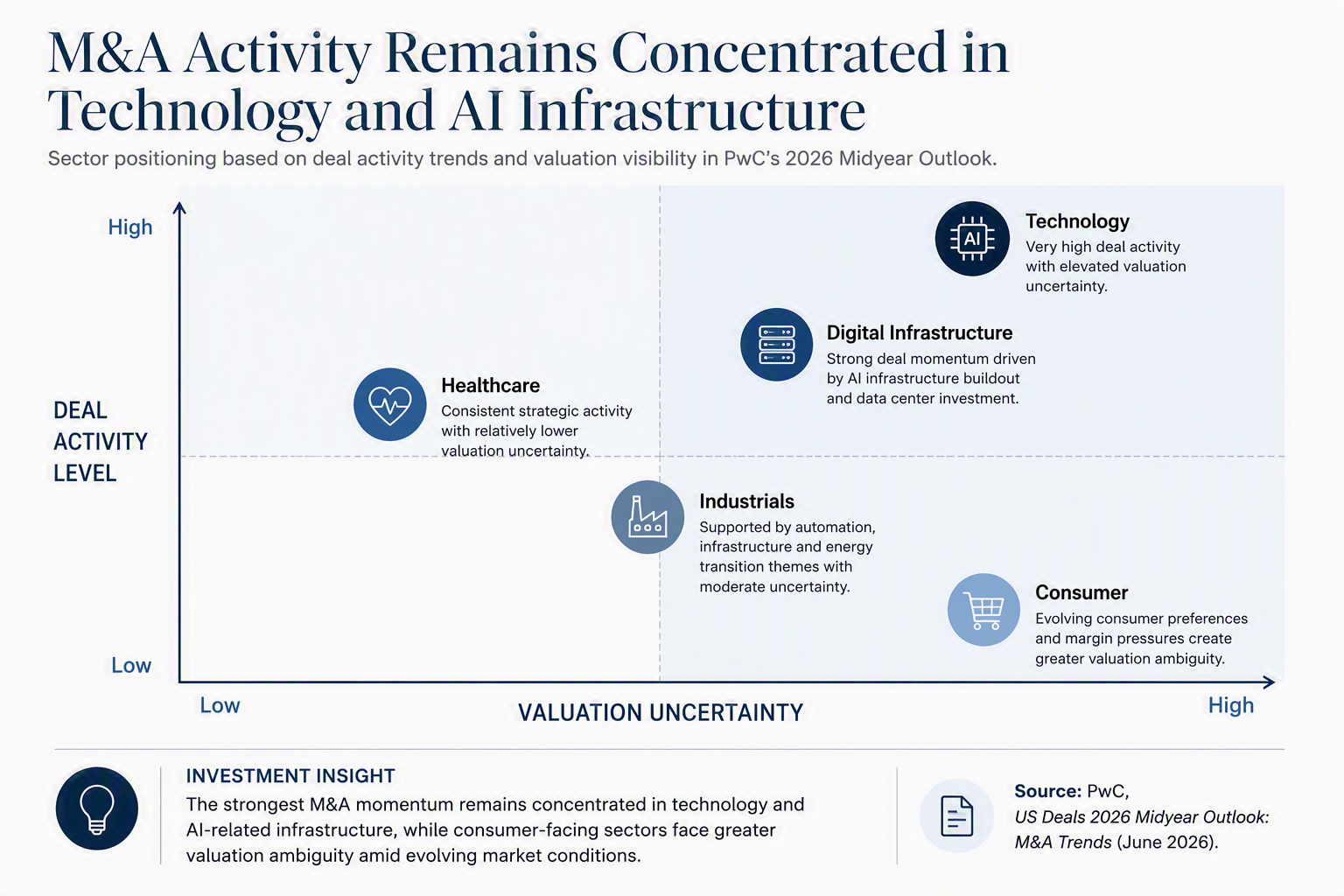
While technology grabs headlines, healthcare has quietly become one of private equity’s most resilient sectors for deployment. Take-private transactions and platform roll-ups have continued even as broader dealmaking has been uneven, supported by the sector’s defensive characteristics and a strong history of successful exits. One of 2026’s largest transactions—Blackstone and TPG’s take-private of Hologic, valued at up to $18.3 billion and completed in April—is a reminder that scaled healthcare platforms still command serious institutional conviction.5
Healthcare’s appeal isn’t complicated. Demand is largely non-discretionary, fragmentation creates room for consolidation, and there is a long runway for operational improvement in businesses that were never built with private equity–style discipline. It’s a sector where “value creation” isn’t a slide in a pitch deck—it’s a measurable improvement in how care gets delivered and paid for.
Industrials Are Being Rebuilt Around Reshoring and Resilience
Industrials have re-emerged as a favored sector, driven by supply chain reshoring, infrastructure investment and mid-market buy-and-build strategies that consolidate fragmented operators into scaled platforms. This isn’t a bet on industrial growth for its own sake—it’s a bet on the years-long process of rebuilding supply chains that were exposed as fragile, and on the operators disciplined enough to execute that rebuild profitably.
Notably, industrials are also becoming an indirect beneficiary of the AI buildout: companies supplying the cooling systems, power equipment and thermal management infrastructure that data centers require are commanding some of the highest valuations in the market. It’s a useful illustration of how sectors that look unrelated on the surface—industrials and digital infrastructure—are increasingly the same trade.
Technology and Consumer: Selective, Not Absent
It would be a mistake to read this shift as “AI good, everything else out.” Technology remains a sector with enormous long-term value, but the environment has grown more complex: AI is disrupting the economics of legacy software holdings even as it opens new avenues for value creation, making exits harder to time and underwrite. Consumer markets tell a similar story of selectivity—broad consumer exposure is out of favor amid margin compression, but large carve-outs and take-privates where operational improvement is clearly achievable continue to find capital.
The takeaway isn’t that these sectors are closed. It’s that the era of buying broad exposure and waiting for the market to do the work is over. Conviction now has to be sector-specific and thesis-driven.
Private Credit Is the Connective Tissue
Running underneath nearly every sector above is the growth of private credit, particularly asset-based and structured finance. As banks pull back from complex, capital-intensive financing, private lenders are stepping into the gap—from data center construction loans to specialized structures banks are no longer positioned to underwrite. The scale is visible in the market’s largest borrowers: direct debt issuance by U.S. hyperscalers reached $115 billion in the first quarter of 2026 alone, compared with $70 billion in all of 2025.2 This isn’t a side story to the sectors above; it’s the financing mechanism making many of them possible.
The JLS Perspective
None of the sectors above are compelling because they’re trending. They’re compelling because each one rewards the same underlying discipline: patient capital, operational depth and the willingness to understand an industry well enough to improve it, not just fund it. That is the thread connecting digital infrastructure, healthcare, industrials and private credit—and it’s the same thread that has always guided how we think about capital allocation and strategic partnership.
The sectors worth watching change every cycle. The discipline required to invest in them well does not.
Sources
1. Bain & Company, Global Private Equity Report 2026, press release, February 23, 2026. bain.com
2. S&P Global Ratings, hyperscaler capex and credit analysis, 2026, as reported by FI Desk. fi-desk.com
3. McKinsey & Company, “The cost of compute: A $7 trillion race to scale data centers,” April 2025; “Data center demands” chart. mckinsey.com
4. Boston Consulting Group, Infrastructure Strategy 2026: A Year of Increasing Scale and Diversification, March 2026. bcg.com
5. Hologic, Blackstone and TPG, “Blackstone and TPG Complete Acquisition of Hologic,” April 7, 2026; Radiology Business, October 2025. radiologybusiness.com