- The data center boom is as much a real estate, energy, infrastructure and capital story as a technology story.
- Power availability and speed to power are now the primary drivers of data center site value.
- Scarcity defines the market: North American primary-market vacancy hit a record 1.4% in the first half of 2026.
- Community opposition and permitting have become financial risks that lenders now underwrite directly.
- The best data center investments will be defined by secured power, credible permits and executable delivery, not by the biggest AI story.
When people think about artificial intelligence, they think about software: chatbots, algorithms, models and applications. But behind every AI system is something far more physical: a data center. Rows of servers, miles of fiber, massive cooling systems, substations, power generation, backup infrastructure, land, construction capital and, increasingly, enormous amounts of electricity.
That is why the data center boom is becoming much more than a technology story. It is becoming a story about real estate, energy, infrastructure, private credit, construction and long-term capital allocation.
JLL estimates that nearly 100 gigawatts of new data center capacity will be added globally between 2026 and 2030, effectively doubling global capacity, with the sector growing at roughly a 14% compound annual rate.1 McKinsey’s analysis suggests global data center demand could rise from about 82 gigawatts in 2025 to roughly 219 gigawatts by 2030 under its continued-momentum scenario.2
The numbers are enormous. But the more interesting question is not simply “How many data centers will be built?” It is “What becomes more valuable when computing capacity becomes scarce?” The answer is increasingly clear: power, land, connectivity, permits, construction capacity and capital.
Source: JLL 2026 Global Data Center Outlook; CBRE North America Data Center Trends H1 2026; Data Center Watch via Reuters.
Data Centers Are Real Estate—But Not Ordinary Real Estate
A traditional real estate investor might begin with questions like: Where is the property? How much does the land cost? What is the rent? What is the vacancy rate? For data centers, those questions are only the beginning. The most important question may now be: can the site actually get enough power?
That changes everything. JLL’s 2026 outlook identifies speed to power as the primary criterion driving data center site selection, followed by community support, latency and proximity to customers. With the average wait for a grid connection in primary markets now exceeding four years, operators are increasingly turning to behind-the-meter generation and on-site battery storage to overcome grid constraints.1
This creates a very different definition of prime real estate. A piece of land may look inexpensive, but if it cannot obtain sufficient electrical capacity, its value to a data center developer may be dramatically lower. Another site may be more expensive, but if it has access to transmission infrastructure, available power, fiber connectivity, favorable permitting and an established industrial ecosystem, it may be far more valuable.
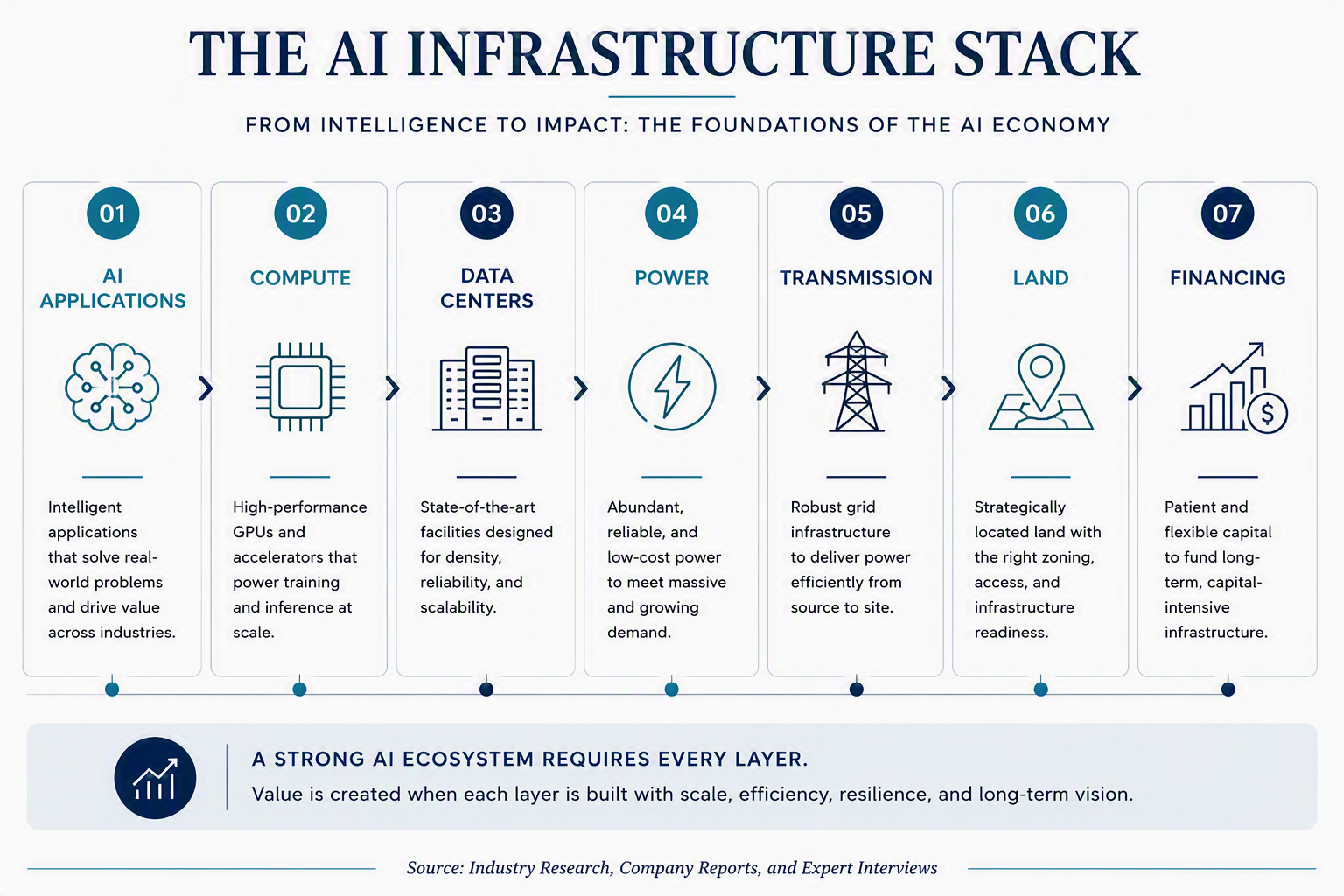
The economic equation becomes: Land + Power + Connectivity + Permitting + Time = Data Center Value. This is one reason data center development increasingly resembles infrastructure investing as much as traditional real estate.
Power Is Becoming the New Location Advantage
For decades, real estate investors talked about three things: location, location, location. For data centers, the equation is evolving: power, power, power.
According to a Department of Energy report produced by Lawrence Berkeley National Laboratory, U.S. data centers consumed about 4.4% of total U.S. electricity in 2023 and could consume roughly 6.7% to 12% by 2028, depending on the pace of expansion and efficiency improvements.3 That is an extraordinary shift in electricity demand, and it creates an entirely new investment ecosystem. Data center growth creates demand for:
- Electricity generation
- Transmission infrastructure
- Substations
- Battery storage
- Natural gas generation
- Renewable energy
- Nuclear power
- Grid modernization
- Cooling technology
- Energy management systems
The data center may be the visible asset. But the larger opportunity can exist in the infrastructure surrounding it.
AI Is Changing the Economics of the Data Center
Not all computing workloads are the same. Traditional cloud computing requires data centers, but AI is dramatically changing the intensity of that demand. Training advanced AI models requires enormous amounts of computing power. Inference—the process of running those models for users—creates another growing layer of demand.
This means data centers increasingly need specialized infrastructure designed around high-density computing, including:
- High-performance GPUs
- Advanced networking
- Liquid cooling
- Higher-density racks
- Larger electrical systems
- More sophisticated power management
- Specialized building designs
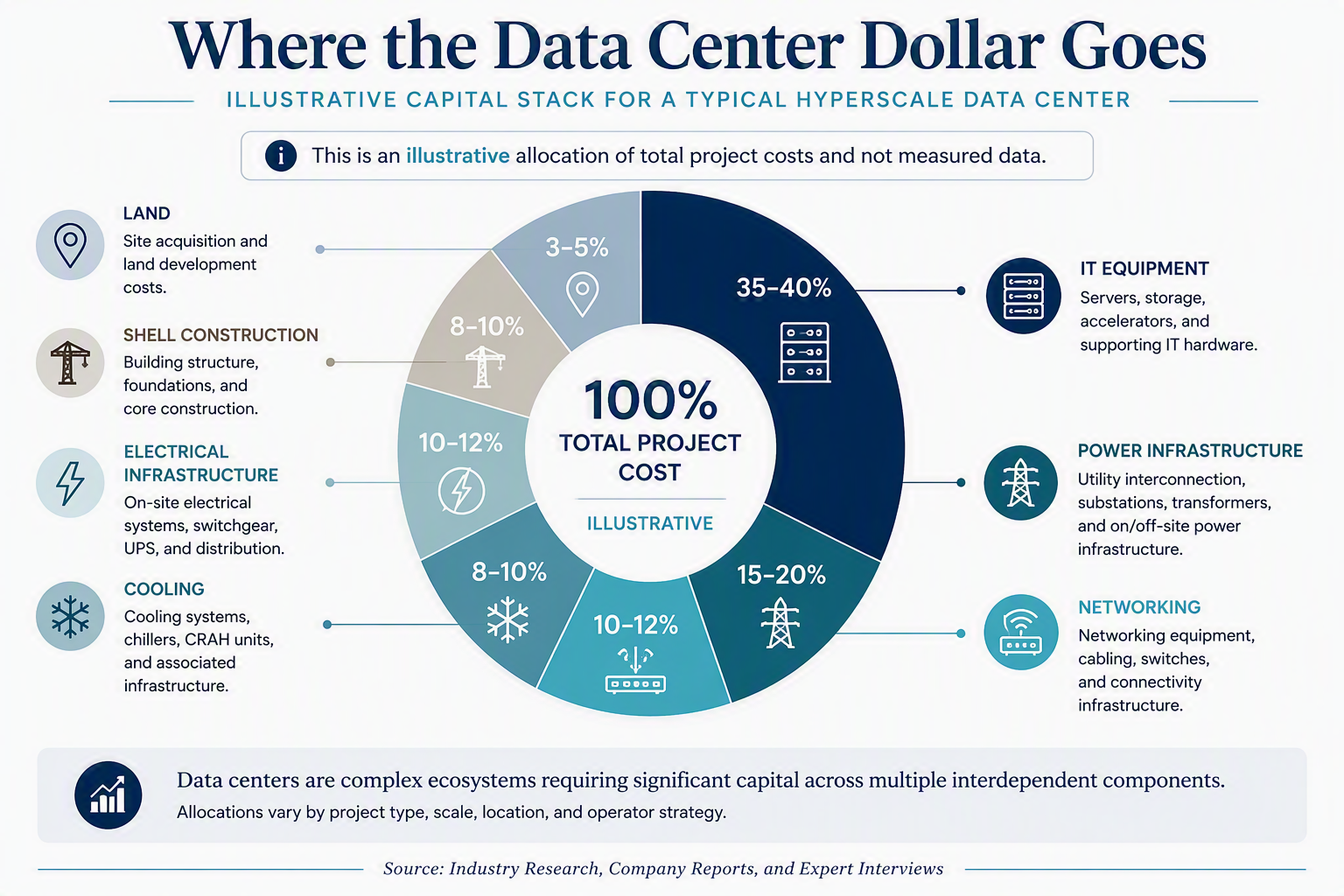
The capital required is substantial. JLL estimates that the roughly 100 gigawatts coming online through 2030 represents about $1.2 trillion in real estate value creation, with tenants likely to spend another $1 trillion to $2 trillion fitting out their space with IT equipment.1 McKinsey’s broader analysis estimates that about $6.7 trillion in global data center investment could be required by 2030, including both AI and traditional computing infrastructure.2
That number changes the conversation. Data centers are no longer simply buildings filled with servers. They are becoming strategic infrastructure assets.
The Hidden Bottleneck: Time
One of the least appreciated economics of the data center boom is time. Demand can appear quickly. Supply cannot. A hyperscaler can decide it needs another campus, but developers still need to secure land, obtain permits, secure power, build substations, construct facilities, install cooling systems, connect fiber, install equipment and complete testing.
The result is a growing premium on projects that can actually be delivered. CBRE reports that capacity under construction in North America reached a record 7,481 megawatts in the first half of 2026, yet power constraints are extending completion timelines, and 80.4% of that capacity was already preleased.4
That creates an important investment principle: the value of a data center is not just the building. It is the ability to deliver computing capacity when customers need it. In that environment, speed becomes an economic asset.
Scarcity Is Creating New Investment Opportunities
When supply is constrained and demand remains strong, scarcity creates pricing power. That is already visible in the data center market. Primary-market inventory in North America grew 33.7% year over year, yet vacancy fell to a record 1.4%, with Northern Virginia at just 0.2%, and CBRE reported rental rate increases across every deployment size.4
This has implications far beyond the largest operators. It creates opportunities for:
- Data center developers
- Landowners
- Infrastructure investors
- Private equity firms
- Private credit providers
- Power developers
- Construction companies
- Equipment manufacturers
- Fiber providers
- Real estate owners
The most interesting opportunities may not always be in owning the finished data center. They may exist earlier in the value chain.
Private Credit Has a Role to Play
Large-scale data center development requires significant capital before revenue begins. Land must be acquired, power infrastructure secured, construction financed and equipment purchased, and projects may require years of development before they become fully operational. JLL estimates the coming wave of supply will require roughly $870 billion of new debt financing.1
That creates a natural role for private credit. Private lenders can potentially finance:
- Land acquisition
- Construction
- Bridge financing
- Development costs
- Recapitalizations
- Equipment
- Infrastructure
- Expansion projects
The opportunity is particularly interesting because data center financing combines real assets with contracted or expected technology demand. But it also introduces complexity. The lender must understand not only the real estate, but also power risk, tenant risk, construction risk, technology risk, permitting risk and exit risk. This is where the operator’s perspective becomes important.
“When demand is abundant, the scarce input often captures the greatest value.”
JLS Capital InsightsThe New Investment Risk: Power and Permitting
The data center boom is creating another hidden economic issue: not every community wants one. Data centers can require significant electricity and, depending on cooling systems and local conditions, substantial water resources. They can also generate noise, traffic and visual impacts.
In 2026, community opposition has become an increasingly important consideration for lenders and developers. Reuters reported that at least 75 U.S. projects worth about $130 billion faced local opposition in the first quarter of 2026, according to Data Center Watch, and that banks now weigh community sentiment, permitting and project readiness alongside credit quality when assessing loans.5 In July, Blackstone-owned QTS terminated its Prince William Digital Gateway project in Virginia after strong local opposition.
That changes underwriting. Historically, investors might have focused primarily on land → power → tenant. Now the equation increasingly looks like land → power → permits → community → tenant. A project can have an excellent site and strong tenant demand and still fail if it cannot obtain the necessary approvals. This is an important lesson for investors: regulatory and community risk can become financial risk.
The Geography of Data Centers Is Changing
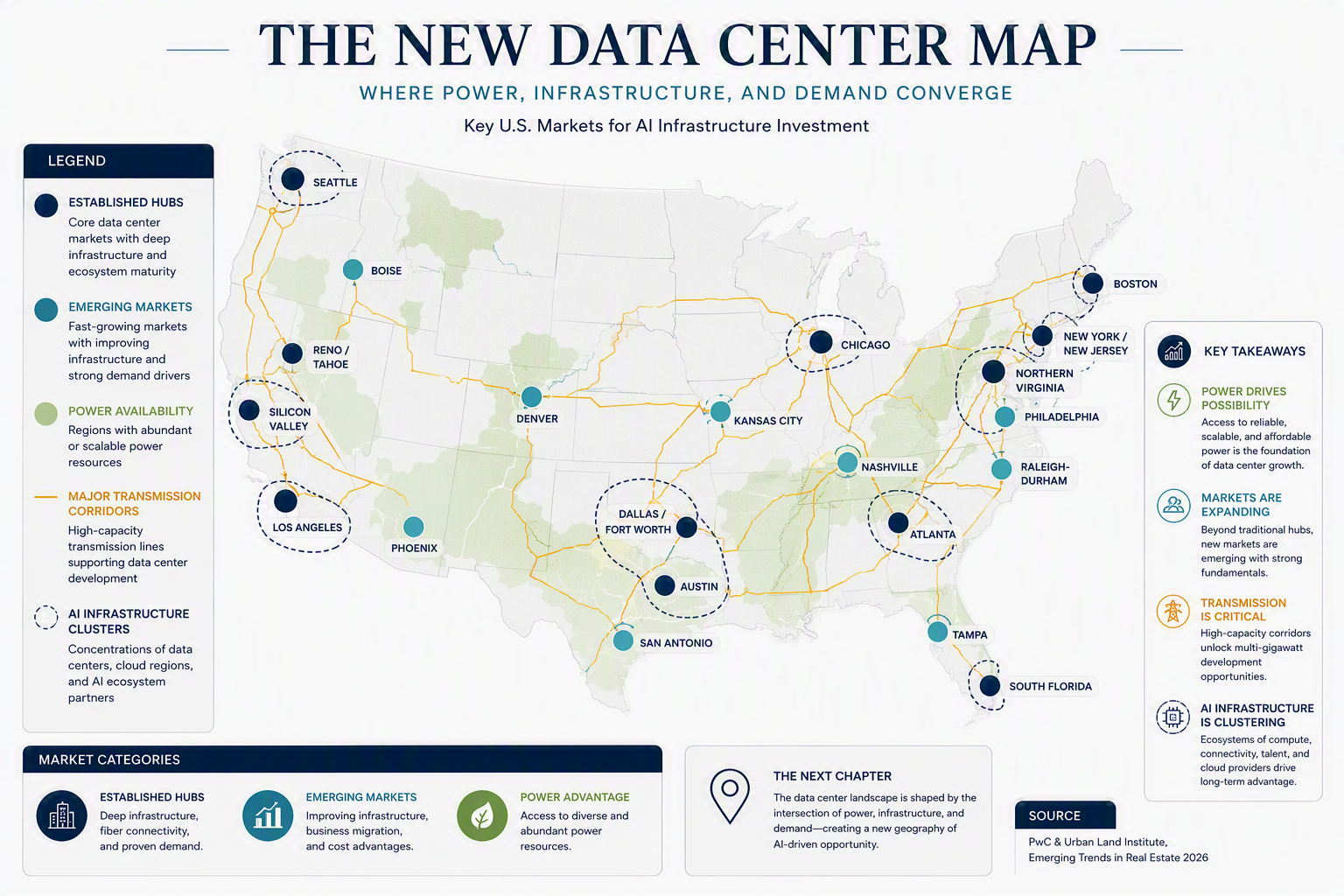
Northern Virginia has historically dominated the U.S. data center market, and it remains the largest, with about 4.5 gigawatts of inventory.4 But the next phase of growth is creating a broader geographic map that includes Texas, Arizona, Georgia, Ohio, Illinois, Michigan and the wider Midwest and South.
Different markets offer different combinations of:
- Power availability
- Land
- Tax incentives
- Fiber
- Renewable energy
- Industrial infrastructure
- Regulatory environments
- Workforce
- Proximity to customers
The winning markets may not necessarily be the cheapest. They will be the markets capable of delivering power at scale and speed. That is a very different investment thesis from traditional real estate.
Data Centers Are Creating a Second-Order Real Estate Effect
The economic impact does not stop at the data center. A large facility requires construction workers, and those workers need housing. The facility requires maintenance teams, and those employees need services. New infrastructure requires contractors, contractors need suppliers, and additional electricity demand can lead to new generation and transmission investment. Industrial ecosystems begin forming around major campuses.
This creates a second-order real estate effect. The data center may occupy hundreds of acres, but its economic footprint can extend across an entire region. That creates opportunities in:
- Industrial real estate
- Multifamily housing
- Hotels
- Retail
- Logistics
- Land development
- Infrastructure
- Workforce housing
The most interesting investment question may therefore be: what happens around the data center?
The Hidden Economics: Data Centers Are Really About Scarcity
The most important insight may be the simplest. AI is not creating unlimited demand for data centers. It is creating demand for a limited set of resources. Power is limited. Transmission capacity is limited. Prime land is limited. Construction capacity is limited. Permitting capacity is limited. Specialized equipment is limited. And time is limited.
That is why the economics of the industry are becoming increasingly defined by scarcity. Investors who understand those constraints may have an advantage over investors who focus only on the headline growth numbers. Because when demand is abundant, the scarce input often captures the greatest value.
Looking Beyond the AI Hype
The data center opportunity is enormous. But that does not mean every data center project will be successful. AI demand can change. Technology can become more efficient. GPU architectures can evolve. Power costs can rise. Regulation can change. Communities can resist development. Projects can face construction delays. Capital can become more expensive.
That is why disciplined investors should look beyond the AI narrative. The strongest opportunities will likely be projects where:
- Power is secured.
- Permitting is credible.
- Construction is executable.
- Demand is durable.
- Financing is appropriately structured.
- The surrounding market is economically resilient.
In other words, the best data center investment may not be the one with the biggest AI story. It may be the one with the strongest fundamentals.
The JLS Perspective
At JLS Capital Group, we believe the most interesting investment opportunities often sit at the intersection of multiple industries. Data centers are a perfect example. They are simultaneously real estate, infrastructure, energy, technology, private credit and capital allocation. Understanding that intersection is what makes the opportunity compelling.
The next decade of data center investment will not simply be about building more facilities. It will be about securing the resources required to make those facilities economically viable: power, land, connectivity, capital and execution.
For investors, the lesson is broader than data centers. The greatest opportunities often emerge when one industry’s growth creates demand across several others. That is where the hidden economics begin.
Sources
1. JLL, 2026 Global Data Center Outlook, January 2026. jll.com
2. McKinsey & Company, “The cost of compute: A $7 trillion race to scale data centers,” April 2025; “Data center demands” chart. mckinsey.com
3. U.S. Department of Energy, “DOE Releases New Report Evaluating Increase in Electricity Demand from Data Centers,” December 20, 2024 (Lawrence Berkeley National Laboratory, 2024 Report on U.S. Data Center Energy Use). energy.gov
4. CBRE, “North American Data Center Demand Continues to Outpace Supply Despite Record Construction,” North America Data Center Trends H1 2026, September 8, 2026. cbre.com
5. Reuters, “Lenders scrutinize US data center financing as community opposition builds,” August 10, 2026. reuters.com